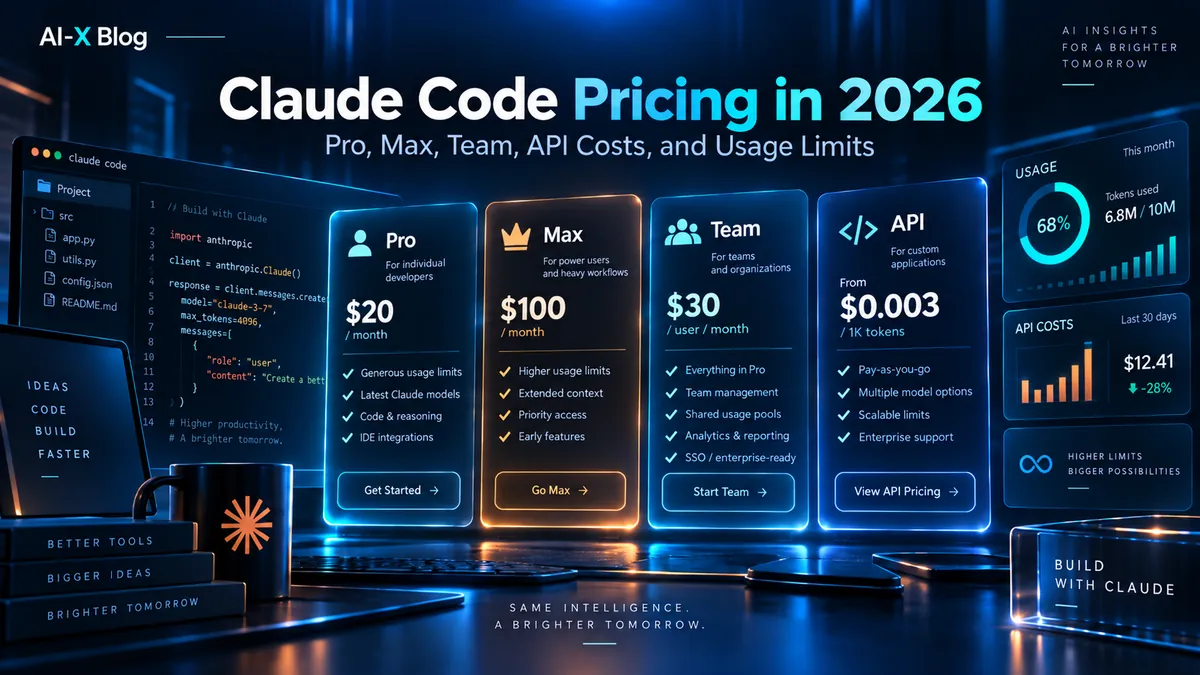
Claude Code pricing is no longer a single “pay per token” decision. In 2026, individuals can get Claude Code inside Pro or Max subscriptions, teams can use it through Team seats, current Enterprise plans combine a seat fee with usage billed at API rates, and developers can still run Claude Code directly against a Console or cloud API account.
The important part is that these billing paths behave differently. A $20 Pro subscription gives you an included usage allowance shared across Claude and Claude Code. An API key does not use that allowance: it creates pay-as-you-go token charges instead. Max raises the included allowance, while usage credits can extend paid plans after their included limits are reached.
Methodology: AI-XBlog verified this guide against Anthropic’s current Claude pricing page, Claude Code product page, Help Center billing and usage documentation, and Claude Platform model pricing on September 24, 2026. This is a documentation-based pricing guide, not a claim that we measured every plan’s practical coding capacity. Anthropic’s usage limits vary by model, context, effort and workload, so we do not invent fixed “prompts per day” numbers.
Claude Code pricing at a glance
| Billing path | Current price | Claude Code access | How usage is billed |
|---|---|---|---|
| Free | $0 | No | Claude chat only; Claude Code is not included |
| Pro | $17/month equivalent with annual billing ($200 upfront), or $20 monthly | Yes | Included usage shared across Claude products; usage credits can continue work after limits |
| Max 5x | $100/month | Yes | 5x Pro usage allowance, still subject to limits |
| Max 20x | $200/month | Yes | 20x Pro usage allowance, still subject to limits |
| Team Standard | $20/seat/month annually, or $25 monthly | Yes | Included seat usage; extra usage can be enabled |
| Team Premium | $100/seat/month annually, or $125 monthly | Yes | 5x Standard seat usage; extra usage can be enabled |
| Enterprise | $20/seat/month on the current plan, plus usage | Yes | Current usage-based Enterprise bills Claude, Claude Code and Cowork at standard API rates from the first token |
| Claude Console / API key | No Claude subscription required; prepaid or invoiced API usage | Yes | Pay per token at the selected model’s API rate |
Prices above are US list prices before applicable tax where Anthropic specifies that taxes are excluded. Team and Enterprise structures can also differ for legacy organizations, so an existing company account may show older seat types.
The most important distinction: subscription usage vs API billing
Claude Code can look identical in your terminal while being billed through two different systems.
- Subscription login: Pro, Max, Team and eligible Enterprise users sign in with their Claude account. Work draws from the plan’s Claude usage allowance or configured usage credits.
- API login: Claude Code uses a Claude Console API key or another supported cloud provider. Usage is billed by tokens at that provider’s model rates.
This distinction matters more than the sticker price. Anthropic explicitly warns that if an ANTHROPIC_API_KEY environment variable is present, Claude Code can authenticate with that key instead of your Pro, Max, Team or Enterprise subscription. That means a developer who believes they are using included subscription usage can instead generate API charges.
If your goal is to stay strictly inside a Pro or Max subscription budget, Anthropic recommends logging in with the subscription account, avoiding Console credentials in that Claude Code session, and declining API-credit continuation when your plan limit is reached.
Claude Code Pro: the lowest-cost individual plan
Claude Pro is the practical entry point for an individual who wants Claude Code without metered API billing. It costs $20 per month on monthly billing, or $200 per year, which Anthropic presents as a $17/month equivalent.
Claude Code is included, but Pro is not unlimited. The same account allowance is shared across Claude chat, Claude Code and other Claude product surfaces. Long sessions, large repositories, expensive models, high effort levels and large context can consume that allowance faster.
Anthropic describes Pro on its Claude Code product page as suitable for short coding sprints in smaller codebases. That wording is more useful than pretending there is a fixed number of prompts: the effective amount of coding you get depends heavily on what the agent is actually doing.
For the broader subscription, models and non-coding features, see our Claude Pricing in 2026 guide.
Claude Code Max 5x: $100/month for heavier daily use
Max 5x costs $100 per month and gives five times the Pro plan’s usage allowance. Anthropic positions it for everyday Claude Code work in larger codebases.
The “5x” is an allowance multiplier, not a promise of five times as many coding tasks. A large multi-agent refactor can consume dramatically more usage than a small bug fix, and usage is still shared with other Claude activity on the same account.
Claude Code Max 20x: $200/month for power users
Max 20x costs $200 per month and provides 20 times the Pro allowance. It is the highest fixed-price individual tier and is intended for users who work with Claude throughout the day.
It is still not an unlimited plan. Anthropic documents both session-based and weekly usage controls, and says it may apply other capacity limits. Max is best understood as a much larger included pool before pay-as-you-go continuation or waiting for a reset becomes necessary.
Claude Code usage limits are shared, not separate
A common pricing mistake is treating Claude Code as if it had its own independent bucket. Anthropic says activity across Claude, Claude Code and other Claude product surfaces counts toward the same plan usage limits.
Usage is affected by conversation length, context, the selected model, the task, features and effort level. Anthropic therefore does not reduce the plans to one reliable public “X prompts every five hours” number that applies to every user.
There was also a meaningful capacity change in May 2026: Anthropic said it doubled Claude Code’s five-hour rate limits for Pro, Max, Team and seat-based Enterprise plans, and removed the peak-hours limit reduction that had applied to Pro and Max Claude Code usage.
That makes older Claude Code pricing articles particularly easy to misread. A page that still quotes pre-May 2026 capacity assumptions can be materially out of date even if its subscription price is correct.
What happens when you hit the limit?
September 23 update: Cloud sessions leave research preview and add launch credit
Anthropic says Claude Code cloud sessions are now officially available and out of research preview. A cloud session runs on Anthropic-hosted infrastructure, so Claude Code can keep working after you close your laptop. You can start or steer cloud work from claude.ai/code, the Code tab in the Claude mobile app, Claude Desktop, or the CLI with claude --cloud.
The billing detail matters. Cloud sessions still sit inside the Claude Code subscription model rather than becoming a separate VM product. Anthropic is also giving eligible existing individual subscribers a one-time cloud-session credit: $100 on Pro and $250 on Max. The credit is separate from normal usage limits, applies to cloud sessions only, and must be claimed by October 7, 2026; Anthropic says GitHub must be connected before starting a session. Do not confuse this promotion with the separate Opus 5.5 rate-limit reset.
For buyers, the practical change is that Pro and Max now cover a more durable remote coding workflow: a developer can start work on one device and let it continue in Anthropic’s cloud. That increases the value of the subscription for long-running repository tasks, but it does not make usage unlimited. Cloud work still consumes model usage, and once any promotional credit is exhausted the account falls back to its normal plan economics.
On Pro and Max, reaching the included allowance does not necessarily mean you must stop. Anthropic now supports usage credits: after the plan allowance is exhausted, you can continue at standard consumption-based rates if you have enabled that option.
- Wait for the plan limit to reset.
- Move from Pro to Max 5x, or from Max 5x to Max 20x, if the limit is consistently too small.
- Enable usage credits and continue at standard API-style rates after the included allowance.
- Use a Claude Console/API account for an intensive or separately budgeted coding workload.
Anthropic also sells prepaid usage bundles after usage credits are enabled. The current published bundles are $50 of usage value for $45, $250 for $200, and $1,000 for $700—discounts of 10%, 20% and 30% respectively. These balances work across Claude, Claude Code, Cowork and other supported Claude surfaces after included usage has been exhausted.
Team pricing: Standard vs Premium seats
Claude Team supports 2 to 150 users and currently includes Claude Code on both seat types.
| Team seat | Annual billing | Monthly billing | Usage positioning |
|---|---|---|---|
| Standard | $20/user/month | $25/user/month | More usage than Pro; Claude Code included |
| Premium | $100/user/month | $125/user/month | 5x Standard-seat usage; Claude Code included |
Team also adds centralized billing and administration, SSO, organization search and connector controls. Owners can enable extra usage so a developer who reaches the seat allowance can continue rather than waiting for a reset.
This makes Team Premium structurally different from simply giving a developer an individual Max subscription: the organization controls billing, identity and spend, while the user receives a larger managed allowance.
Enterprise pricing: the current model is seat fee plus usage
Anthropic’s current pricing page lists Enterprise at $20 per seat plus usage at API rates. The current Enterprise model does not include a token allowance in the seat fee: Claude, Claude Code and Cowork consumption is billed separately from the first token.
That can make Enterprise look inexpensive if you only compare seat prices. The real budget is:
Enterprise cost = seat fees + model usage + any applicable taxes or negotiated terms.
In exchange, organizations get controls that are not the point of individual plans: user- and organization-level spend limits, SCIM, audit logs, Compliance API access, retention controls, network restrictions, IP allowlisting and other enterprise governance features.
Legacy Enterprise customers can still encounter older seat-based structures such as Premium or Chat + Claude Code seats. If your organization predates the current single-seat model, use the billing model shown in your organization settings rather than assuming the new public pricing applies one-for-one.
API pricing: what Claude Code costs with a Console account
If Claude Code is authenticated with a Claude Console API key, there is no fixed Claude Code subscription fee. You pay for model usage. Anthropic says the /cost command can show running session spend for API-billed Claude Code sessions.
| Current model | Base input | Output | Illustrative 1M input + 200K output |
|---|---|---|---|
| Claude Haiku 4.5 | $1 / MTok | $5 / MTok | $2 |
| Claude Sonnet 5 | $2 / MTok | $10 / MTok | $4 |
| Claude Opus 5 | $5 / MTok | $25 / MTok | $10 |
| Claude Opus 5.5 | $4 / MTok | $20 / MTok | $8 |
| Claude Fable 5.1 | $10 / MTok | $50 / MTok | $20 |
Opus 5.5 materially improves the Claude Code cost curve. Anthropic launched it on September 22, 2026 at $4/MTok input and $20/MTok output, with $0.20/MTok cache reads, $5/MTok 5-minute cache writes, and $8/MTok 1-hour cache writes. Fast mode is available in Claude Code at $8/MTok input and $40/MTok output for up to 2.5× speed. Anthropic also says standard Opus 5.5 output is more than 30% faster than Opus 5, while the 1M-token context window and 128K standard max output make it suitable for long-running coding work. If you migrate an API-backed Claude Code workflow from Opus 5, test the documented breaking changes: thinking can no longer be disabled, forced tool choice is unsupported, thinking-block compatibility changed, and older computer-use tool integrations may need updating.
Fable 5.1 has a materially cheaper prompt-cache read rate than Fable 5. Anthropic currently prices Fable 5.1 at $10/MTok base input, $50/MTok output, $12.50/MTok for 5-minute cache writes, $20/MTok for 1-hour cache writes, and just $0.25/MTok for cache hits and refreshes. Fable 5 used $1/MTok for cache reads, so the new model cuts that repeated-context component by 75%. For repository-heavy or long-running Claude Code workloads that repeatedly reuse context, this can materially lower effective API cost even though the base input and output prices did not change.
The last column is simple list-price arithmetic, not a claim about typical Claude Code sessions. A real coding session can reuse cached context, call tools repeatedly, run subagents, compact context, switch models, or consume very different input/output ratios.
For example, the illustrative Sonnet 5 case is:
(1.0 × $2 input) + (0.2 × $10 output) = $4
Scale the same workload tenfold to 10M input tokens and 2M output tokens and the base model charge becomes $40 on Sonnet 5, $100 on Opus 5, or $200 on Fable 5.1 before considering caching or other priced features.
Claude Code 2.1.278 removes most auto-mode classifier overhead charges
Anthropic changed an important part of Claude Code billing in version 2.1.278. For Claude API and Enterprise users, and supported sessions on Amazon Bedrock, Google Cloud’s Agent Platform, Microsoft Foundry and Claude apps gateways, auto mode now asks the server to run its safety classifier by default. When those server-side checks are available, Anthropic does not charge separately for the classifier requests.
This is not a blanket promise that auto mode is always free. If server-side checks cannot reach the session—because of platform rollout, region, credentials, or a gateway/proxy that alters the required request or response fields—Claude Code falls back to its own classifier requests and bills them as before. Version 2.1.278 or later shows a warning when that fallback becomes billable, and /status shows whether the session is using the server-side classifier. Anthropic says Pro, Max and Team plans do not show this billing notice.
For API and enterprise deployments, this means older cost estimates that included routine auto-mode classifier overhead can now overstate spend when server-side checks are active. The underlying model-token charges for the coding work itself do not disappear.
Do not confuse classifier-overhead billing with refusal billing. Anthropic’s separate refusal rules still apply when an Opus 5.5 or Fable request itself is declined: pre-output refusals in the bio, frontier_llm, and reasoning_extraction categories are currently billed at the requested model’s normal rate, other pre-output refusal categories are not billed, and mid-stream refusals bill the input plus any output already streamed. If fallback runs after a billable refusal, the fallback request can be billed as a separate model attempt, with fallback credit covering the duplicate prompt-cache setup cost rather than the entire second request.
Prompt caching can change API economics
Agentic coding repeatedly revisits repository context, instructions and prior work. Anthropic’s API pricing therefore includes separate prompt-cache write and cache-read rates. Cache hits are cheaper than sending the same material as fresh base input, so two sessions with similar visible behavior can have different effective costs depending on how much context can be reused.
This is one reason a raw “tokens × list price” estimate should be treated as a planning baseline, not a guaranteed Claude Code bill.
The 1M context window is not the same as a 1M-token allowance
Paid Claude Code plans support a 1M-token context window on several current models, including Sonnet 5, Opus 5, Opus 5.5 and Fable 5.1. That describes how much context the model can work with in a session. It does not mean a Pro subscriber receives one million free tokens per reset or that using the full window has no impact on usage.
Large contexts can be useful for big repositories, but they also affect how quickly subscription allowance or API spend is consumed. Treat context capacity and billing capacity as two separate constraints.
How to choose the cheapest Claude Code billing path that still works
| Your workflow | Plan to consider first | Why |
|---|---|---|
| Occasional coding, small fixes, short sessions | Pro | Lowest fixed-price individual entry point with Claude Code included |
| Daily coding in larger repositories | Max 5x | Much larger included pool without immediately moving to pure metered billing |
| Claude Code is a major part of your workday | Max 20x | Largest individual included allowance |
| 2–150 person company | Team Standard / Premium | Central billing, identity and controls; mix seats by workload |
| Large organization with governance requirements | Enterprise | Spend controls, audit/compliance and network controls; usage-based economics |
| CI, automation, SDK, separate cost center or highly variable bursts | API / Console | Direct usage billing, measurable session cost and no subscription allowance ceiling |
The decision becomes more interesting for developers comparing Claude Code with Cursor. Cursor has its own subscription and usage model, so compare the full workflow rather than just $20 vs $20. Our Cursor vs Claude Code guide covers the product differences, while Cursor Pricing in 2026 explains Cursor’s current plan structure.
Five Claude Code pricing mistakes to avoid
- Assuming Pro includes API usage. A Pro subscription and Claude Console API billing are separate systems.
- Leaving an API key in your environment and expecting subscription usage. Anthropic specifically warns that
ANTHROPIC_API_KEYcan make Claude Code use API billing instead. - Calling Max “unlimited.” Max has higher limits, not unlimited use.
- Comparing Enterprise on the $20 seat fee alone. Current Enterprise usage is billed separately at API rates.
- Using old Claude Code capacity estimates. Anthropic doubled five-hour Claude Code rate limits for several paid plans in May 2026, so older usage assumptions can be stale.
Claude Code pricing and multi-agent work
Claude Code is increasingly able to fan one goal out across multiple sessions, subagents and longer-running workflows. That changes cost behavior. One request can create substantially more model work than one interactive coding exchange.
For example, the redesigned Claude Code Projects experience can coordinate multiple cloud threads in parallel. Those threads draw from plan usage, so orchestration can reach an allowance faster than a single-session workflow.
If you automate Claude Code through CI, our Claude Code GitHub Actions security-first guide also explains why billing is only one part of the decision: permissions, secrets and merge authority need explicit boundaries.
Frequently asked questions
Is Claude Code free?
Claude’s Free plan does not currently include Claude Code. Individuals can get Claude Code through Pro or Max, while developers can also use Claude Code with a separately funded Claude Console/API account.
Does Claude Pro include Claude Code?
Yes. Claude Code is included in Pro. Pro is $20/month on monthly billing or $200/year on annual billing. The included usage is shared with your other Claude activity.
Is Claude Code unlimited on Max 20x?
No. Max 20x provides 20 times the Pro allowance, but Anthropic still applies usage limits. If you exhaust included usage, you can wait for reset or use configured usage credits.
Does Claude Code API usage come with Pro or Max?
No. Claude Console/API billing is separate from the Pro or Max subscription. A developer can intentionally switch to API credits, but those charges are not included in the subscription price.
Does Team Standard include Claude Code?
Yes under Anthropic’s current Team pricing. Both Standard and Premium Team seats include Claude Code; Premium provides five times the Standard-seat usage allowance.
How do I see Claude Code API cost?
For API-billed Claude Code sessions, Anthropic documents the /cost command for session spend. Subscription users can use /status to monitor plan allocation.
Bottom line
For most individual developers, Claude Code pricing starts with a subscription decision, not a token calculator. Pro is the lowest fixed-price entry point, Max 5x and Max 20x buy substantially more included capacity, and usage credits provide a bridge to pay-as-you-go work after those limits.
API billing becomes more attractive when the workload is automated, bursty, separately budgeted or needs clean per-session cost accounting. Team and Enterprise add organization-level controls, but current Enterprise economics are fundamentally consumption-based: the seat fee is only the access layer.
The biggest billing trap is simple: know which identity Claude Code is using. A subscription login consumes plan allowance; an API key consumes paid API credits. Check that before debugging the price later.
Primary sources
- Claude Developers: Claude Code cloud sessions are officially available
- Claude: Plans & Pricing
- Claude: Claude Code product page
- Claude Help Center: Use Claude Code with your Pro or Max plan
- Claude Help Center: Use Claude Code with your Team or Enterprise plan
- Claude Help Center: How usage and length limits work
- Claude Help Center: How large is the context window on paid Claude plans?
- Claude Help Center: Manage usage credits for paid Claude plans
- Claude Help Center: Buy usage bundles
- Claude Platform Docs: Model pricing
- Claude Platform Docs: Claude Opus 5.5
- Claude Platform Docs: What’s new in Opus 5.5
- Claude Code Docs: Auto mode classifier request charges
- Claude Platform Docs: Refusals and fallback
- Anthropic Claude Code v2.1.278 release notes
- Anthropic: Higher usage limits and a SpaceX compute deal
Verification scope: core plan prices and model availability were last fully verified September 24, 2026; refusal/fallback billing and the distinction from auto-mode classifier overhead were rechecked September 27, 2026. Claude plan prices, model availability and usage policies can change; AI-XBlog treats this as living content and updates the page when Anthropic changes the underlying billing model.
AI-XBlog Weekly Brief
Keep up with AI that actually works
Join the AI-XBlog Weekly Brief for major AI updates, practical workflows, useful tools, and editor’s picks. No daily noise.
Reader discussion
Join the discussion
Have you tried this tool or workflow? Share your experience, corrections, or questions. Useful reader feedback may help us improve this article.
All comments are reviewed before publication. Your email address will not be published. Promotional links and low-value spam are removed.