Claude Code Projects changed from a workspace for related chats into an orchestration layer for longer-running work. In the redesigned beta announced September 17, 2026, you give a Project a goal and context, then a coordinator can break that goal into parallel Claude Code threads, track the work, review outputs and bring the result back into one conversation.
This matters because “Project” now means something different depending on which version of Claude you have. Existing Claude Projects still work as knowledge-backed workspaces, while the new version is rolling out in stages starting with Claude Code.
Methodology: this is a documentation-verified explainer based on Anthropic’s September 17, 2026 Projects announcement, the current Claude Help Center, Claude Code Routines documentation, and current Cursor Projects documentation. AI-XBlog is not presenting this article as a hands-on benchmark of the beta. Availability and limits can change during rollout.
The quick answer
The new Claude Code Projects model has four important pieces: a coordinator that directs the work, threads that run as full Claude Code cloud sessions, shared memory that carries project context forward, and a Library that collects files you add plus artifacts Claude produces.
- Use Projects when one outcome can be split into several related workstreams that need shared context.
- Use Routines when the main requirement is a schedule, API call or event trigger.
- Use GitHub Actions when the automation belongs in CI and repository workflow policy should remain the execution boundary.
- Use ordinary Claude Code sessions or subagents when the job is smaller and does not need a persistent project-level coordinator.
What changed: old Projects vs the new Claude Code Projects
| Area | Existing Claude Projects | New Projects beta |
|---|---|---|
| Primary shape | Workspace with related chats, project knowledge and instructions | One coordinator conversation directing multiple work threads |
| Execution | Chats are primarily user-directed conversations | Claude can split a goal into parallel cloud threads |
| Context | Project knowledge and instructions | Shared memory plus files, repositories, instructions and Library artifacts |
| Long-running work | You manage separate chats and handoffs | Coordinator tracks delegated threads and assembles results |
| Current rollout | Existing version remains available | Beta starts with select Pro and Max Claude Code users; broader rollout follows |
The naming overlap is important. Anthropic says existing projects keep working as they do today while the new experience expands across Claude Code, then chat, Cowork, Team and Enterprise. Do not assume that seeing “Projects” in one Claude surface means you already have the redesigned coordinator experience.
How the coordinator-and-threads architecture works
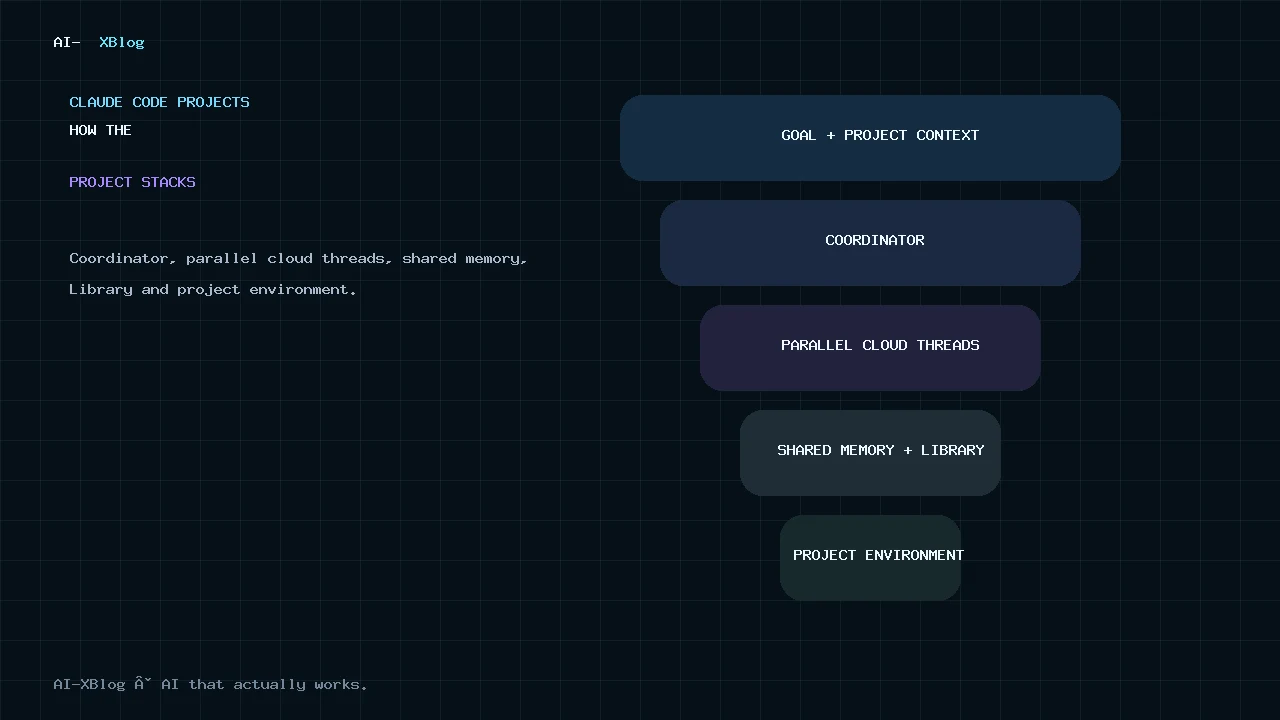
A new Project starts with a goal plus repository or other context. Anthropic says the coordinator can scope the request, delegate work, coordinate parallel threads, review their outputs and assemble the finished result.
| Component | Role | Practical implication |
|---|---|---|
| Coordinator | Directs and tracks the work | You steer the project at the outcome level instead of micromanaging every session |
| Thread | A full Claude Code cloud session | Different workstreams can run in parallel |
| Shared memory | Carries project decisions and working context forward | New threads can build on what earlier threads learned |
| Library | Collects files you add and artifacts Claude produces | Project outputs become reusable inputs for later work |
| Project environment | Cloud environment, connectors, plugins, instructions and model configuration | The Project is more than a chat history; it has an execution and tool context |
Anthropic’s example is a good mental model: give a Project a goal such as reducing checkout latency, then let separate threads profile endpoints, test changes and open pull requests in parallel. Another example connects API, web and mobile repositories so separate threads can migrate each caller while the coordinator tracks merge order.
Shared memory is the feature that changes the workflow most
Parallel agents are not new by themselves. The more important change is that Claude Projects makes the parallel work part of a persistent project context. Anthropic says every thread adds to and draws from shared memory, including project details, decisions and working preferences.
That can reduce repeated onboarding prompts, but it also raises the value of keeping project context clean. A wrong assumption that enters shared context can influence later work. For consequential repositories, treat memory and generated artifacts as working material that still needs review rather than as an unquestioned source of truth.
The Library is different from memory
Memory is about what Claude carries forward about the project and how you work. The Library is the collection of files you add and artifacts Claude produces. That separation is useful: decisions and working context can persist without forcing every output to live inside one chat transcript.
Who has access right now?
As of September 25, 2026, the redesigned Projects experience is still a staged beta. Anthropic says it is available to select Pro and Max subscribers who use Claude Code cloud sessions. More Pro and Max Claude Code users are being added first; chat, Cowork, Team and Enterprise support comes later.
- If you are on Pro or Max and do not see the new Projects experience yet, that does not necessarily indicate an account problem.
- Existing Projects continue working during the transition.
- Anthropic provides a waitlist for eligible Pro and Max users who do not yet have access.
- The new experience should not be treated as universally available across every Claude plan or surface yet.
Usage can increase quickly when several threads run at once
Each worker thread is a full Claude Code session. Anthropic explicitly warns that a Project running several threads can reach plan usage limits faster. Projects draw from the same plan usage as other Claude activity rather than creating a separate unlimited pool.
This changes how to think about cost control. The unit of work is no longer just “one prompt to one coding session.” A single project goal can fan out into multiple concurrent sessions, each consuming usage. Anthropic lets you choose model and effort levels for the coordinator and worker threads, so those choices become part of the operating cost.
For Claude Code-specific subscription tiers, shared usage limits, usage credits and API costs, see our Claude Code Pricing in 2026 guide.
Claude Projects vs Routines vs subagents vs GitHub Actions
| Mechanism | Best fit | What starts the work | Context model |
|---|---|---|---|
| Claude Code Projects | Multi-workstream goals with shared project context | You steer a coordinator toward a goal | Persistent project memory, Library, files, repos and instructions |
| Claude Code Routines | Repeatable unattended automation | Schedule, API call or supported event such as GitHub activity | Saved routine configuration: prompt, repositories and connectors |
| Claude Code subagents | Delegating parts of a session or task | The active Claude Code workflow delegates | Task-specific agent context rather than a persistent Project coordinator |
| GitHub Actions | Repository and CI policy-bound automation | GitHub workflow events and schedules | Workflow YAML, repository context, GitHub permissions and secrets |
Projects and Routines are especially easy to confuse because both can run while your laptop is closed. The key distinction is intent: Projects organize and coordinate a body of work; Routines package an automation so it can fire repeatedly or in response to an external trigger.
If the work belongs inside CI, our Claude Code GitHub Actions security-first setup guide explains how to keep review-only and write-capable automation separated.
Claude Code Projects vs Cursor Projects
Cursor launched its own Projects feature on September 10, one week before Anthropic announced the redesigned Claude Projects beta. Both products now use a coordinator model above parallel coding agents, but their current implementations are not identical.
| Area | Claude Code Projects | Cursor Projects |
|---|---|---|
| Coordinator | Directs parallel Claude Code threads and assembles results | Directs agents; Cursor says the coordinator plans/delegates rather than writing code itself |
| Shared context | Shared project memory plus Library, repos, files and instructions | Shared files/context that cloud and local agents can update and reuse |
| Cloud execution | Threads run in the cloud today | Projects run on their own cloud computer |
| Local execution | Anthropic says local thread execution is coming | Coordinator can already spin up a local agent when work needs the user’s machine |
| Recurring/event work | Handled separately through Routines | Projects can create subscriptions for schedules, Slack and PR activity |
| Current rollout | Staged beta starting with select Pro/Max Claude Code users | Beta rolling out to Cursor users |
The broader comparison is changing quickly. We updated our Cursor vs Claude Code in 2026 guide to account for both coordinator-style Project systems.
Security and control matter more as Projects gain authority
A coordinator that can launch several cloud coding sessions is useful precisely because it can do more work with less supervision. The same property increases the blast radius of bad context, over-broad credentials or a mistaken instruction.
- Keep repository and connector access no broader than the Project needs.
- Review project instructions and shared context for assumptions that should not become durable policy.
- Keep protected branches, required checks and human approval outside the model’s control for consequential merges.
- Watch usage when parallel threads fan out from one request.
- Treat files and tool outputs from untrusted sources as potentially adversarial input.
These are system-level controls, not prompt-writing tricks. Our AI Agent Security in 2026 guide covers prompt injection, least privilege, execution boundaries and runtime controls in more detail.
When a Claude Code Project makes sense
- A migration spans several repositories or components that can be worked in parallel.
- A feature has research, implementation, testing and documentation workstreams that share decisions.
- You want one place to steer a longer body of work instead of manually coordinating many cloud sessions.
- Project memory and reusable artifacts are valuable across days or weeks of work.
- The work is important enough to benefit from orchestration but still reviewable through normal engineering controls.
When to use something simpler
- Use one Claude Code session for a small, tightly scoped change.
- Use a Routine when the defining requirement is “run this every night” or “run this on an event.”
- Use GitHub Actions when CI permissions, auditable workflow configuration and repository events should define the boundary.
- Wait for broader Projects rollout if your team depends on Team/Enterprise availability or local-only execution.
A practical rollout checklist
- Start with a non-critical repository or a goal with reversible output.
- Write a clear outcome and define what must remain human-approved.
- Limit repositories, connectors and plugins to what the goal requires.
- Choose coordinator and worker models deliberately instead of defaulting every thread to the most expensive configuration.
- Watch how many threads Claude creates and how quickly plan usage changes.
- Review shared memory and Library artifacts before using the Project for more consequential work.
- Keep merge policy, secrets and production deployment controls outside the Project’s discretionary authority.
Frequently asked questions
Is the new Claude Projects experience available to everyone?
No. As of September 25, 2026, the redesigned experience is a staged beta starting with select Pro and Max users in Claude Code. Anthropic says broader Claude Code access comes first, with chat, Cowork, Team and Enterprise later.
Do existing Claude Projects disappear?
No. Anthropic says existing Projects keep working during the rollout. The company plans to upgrade them as the redesigned experience expands to chat and Cowork.
Are Claude Project threads local or cloud-based?
They are cloud-based today. Anthropic says running Project threads on your machine with local tools, code and network access is planned but not yet the current default capability.
Does using several threads cost more?
Projects draw from your Claude plan usage, and Anthropic explicitly notes that running several full Claude Code threads in parallel can reach usage limits faster.
Is a Project the same as a Routine?
No. A Project coordinates a body of work through a coordinator and shared project context. A Routine is a saved Claude Code automation that runs on a schedule, API call or supported event trigger.
Bottom line
The redesigned Claude Code Projects feature moves Claude one level above the individual coding session. Instead of manually opening and coordinating several sessions, you can steer one coordinator while parallel threads work against shared project context.
The feature is still early: access is staged, threads are cloud-only today, and parallel work can consume plan usage quickly. But the direction is clear. Claude Code is evolving from an agent you delegate tasks to into a system that can coordinate multiple agents around a longer-running engineering goal.
For the broader framework behind this shift, see our AI Agents in 2026 guide.
Primary sources
- Anthropic: Projects redesigned — from folder to conversation
- Claude Help Center: What are projects?
- Anthropic: Introducing routines in Claude Code
- Cursor: Introducing Projects
- Cursor Docs: Projects
AI-XBlog Weekly Brief
Keep up with AI that actually works
Join the AI-XBlog Weekly Brief for major AI updates, practical workflows, useful tools, and editor’s picks. No daily noise.
Reader discussion
Join the discussion
Have you tried this tool or workflow? Share your experience, corrections, or questions. Useful reader feedback may help us improve this article.
All comments are reviewed before publication. Your email address will not be published. Promotional links and low-value spam are removed.