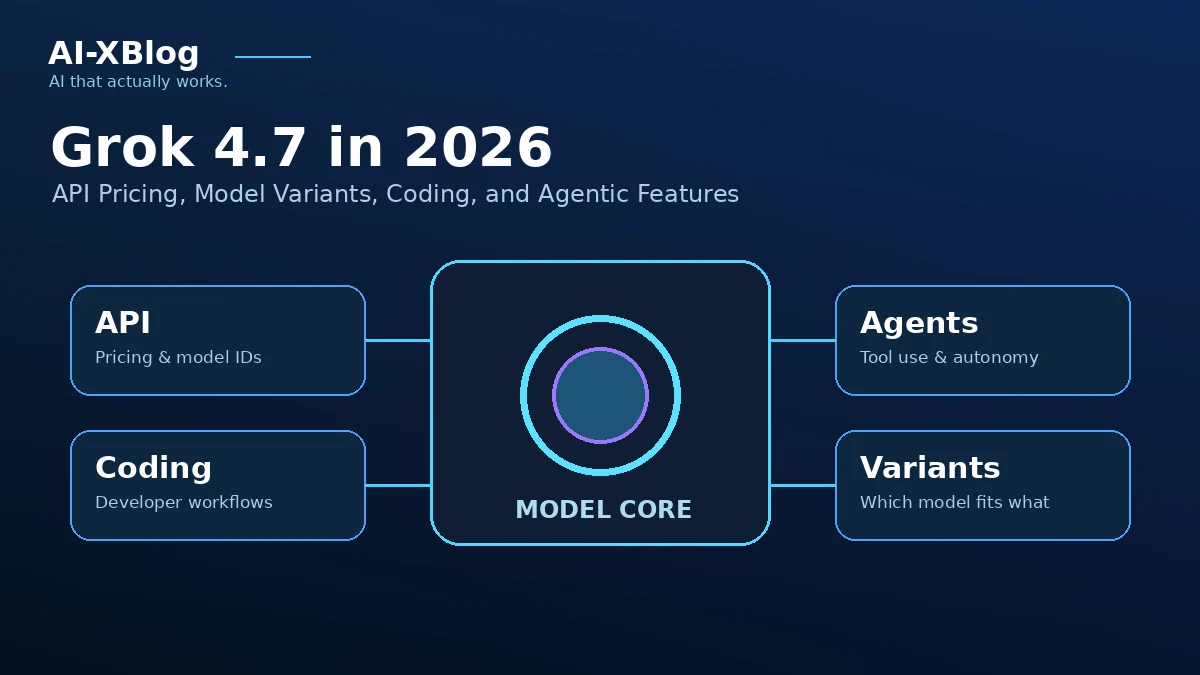
SpaceXAI released Grok 4.7 on September 21, 2026, positioning it as the company’s new flagship for coding, agentic workflows, and knowledge work. The headline is not only higher capability: xAI kept the base API list price at $2 per million input tokens and $6 per million output tokens, while moving to a larger base model and extending reinforcement learning toward longer, multi-hour tasks.
For developers, the practical details matter more than the launch headline. The production model ID is grok-4.7, the documented context window is 500,000 tokens, the knowledge cutoff is May 2026, and current information requires xAI’s Web Search or X Search tools. Grok 4.7 is available through the Grok API, Grok Build and Cursor, while GitHub says it is rolling out gradually across Copilot products.
Methodology note: this article separates xAI’s own benchmark claims from independent evaluation data. AI-XBlog has not run a private Grok 4.7 benchmark, so we do not present vendor scores as our own testing.
Grok 4.7 at a glance
| Item | Grok 4.7 |
|---|---|
| Release date | September 21, 2026 |
| API model ID | grok-4.7 |
| Context window | 500K tokens |
| Input price | $2 per 1M tokens |
| Output price | $6 per 1M tokens |
| Fast variant | About 2× output speed at 2× the base token price |
| Reasoning | Configurable |
| Knowledge cutoff | May 2026 |
| Current information | Requires Web Search or X Search tools |
| Initial availability | Grok API, Grok Build, Cursor, third-party coding harnesses, routers and cloud platforms; GitHub Copilot rolling out |
What changed from Grok 4.6?
xAI says Grok 4.7 uses a new, larger base model than Grok 4.6 and received a longer reinforcement-learning run on a harder task mixture, with more weight on work that can take hours rather than a few turns. The company also says the model is better at verifying its own work and managing long context.
The most important commercial change is what did not change: the base API list price remains the same as Grok 4.6. That makes 4.7 a relatively low-friction model to evaluate for existing xAI API workloads, although a same per-token price does not guarantee the same total bill. A model can use a different number of reasoning or output tokens depending on the task and effort settings.
| Area | Grok 4.6 | Grok 4.7 | Why it matters |
|---|---|---|---|
| Base API price | $2 input / $6 output per 1M | $2 input / $6 output per 1M | No list-price increase for the standard model |
| Base model | Previous generation | Larger new base model | xAI is targeting higher capability without raising base token rates |
| Long tasks | Designed for long-running agents | Longer RL run weighted toward multi-hour work | More emphasis on sustained coding and knowledge workflows |
| Verification | Existing reasoning stack | xAI says self-verification improved | Potentially useful for multi-step work where error accumulation matters |
| Safeguards | Previous stack | New safeguard stack | xAI reports stronger refusal and jailbreak resistance |
Grok 4.7 API pricing
The standard Grok 4.7 API starts at $2 per million input tokens and $6 per million output tokens. xAI also offers a fast variant with roughly twice the output speed at twice the price. At the current base rates, that implies approximately $4 per million input tokens and $12 per million output tokens for the fast variant.
Those are model-token rates, not a guarantee of total application cost. Search tools, surrounding infrastructure, retries, long-context prompts and the amount of reasoning/output generated can all change the effective cost of a production workflow.
For teams comparing coding models by budget, the interesting part is that xAI is keeping Grok 4.7’s standard list price flat relative to 4.6 while claiming higher performance. That makes a controlled side-by-side evaluation more useful than comparing headline benchmark percentages alone.
Model ID, context window, and knowledge cutoff
xAI’s current developer documentation lists the model as grok-4.7 with a 500K-token context window and configurable reasoning. The documentation also says Grok 4.7’s knowledge cutoff is May 2026.
That cutoff has an important practical consequence: a large context window does not make the model automatically current. xAI explicitly says models do not have access to real-time events unless server-side search tools are enabled. Applications that depend on current news, prices, software releases or changing web data should enable Web Search or X Search rather than assuming the base model already knows what happened after May 2026.
On xAI’s Responses API, the documentation also notes that grok-4.7 returns encrypted reasoning content. Developers migrating existing integrations should validate their response parsing and logging assumptions rather than treating a model-name swap as the only change.
Grok 4.7 in Cursor
xAI says Grok 4.7 is available in Cursor from launch day. Cursor’s current Models & Pricing documentation lists Grok 4.7 inside the Cursor Models pool. Cursor also prices its full-context and fast variants separately, so the xAI base API rate should not be assumed to cover every Cursor configuration.
| Cursor option | Input / 1M | Cache read / 1M | Output / 1M |
|---|---|---|---|
| Grok 4.7 | $2 | $0.50 | $6 |
| Grok 4.7 Fast | $4 | $1 | $12 |
| Grok 4.7 500k | $4 | $1 | $12 |
| Grok 4.7 500k Fast | $6 | $1.50 | $18 |
These are Cursor’s documented per-million-token rates as of September 22, 2026, and they can change independently of xAI’s direct API pricing.
The right question is not simply whether 4.7 is “better” than another coding model. Cursor’s value depends on the model, the agent loop, repository context, tool use and your plan’s usage economics together. If you are choosing a Cursor plan, our Cursor pricing guide explains the current Pro, Pro+, Ultra and Teams structure. If you are choosing between coding environments rather than just models, see our Cursor vs Claude Code comparison.
Grok 4.7 in GitHub Copilot
GitHub announced on September 21 that Grok 4.7 is rolling out gradually in GitHub Copilot. It will be available to Copilot Pro, Pro+, Max, Business and Enterprise plans and can appear in the model picker across VS Code, Visual Studio, Copilot CLI, the Copilot cloud agent, the GitHub Copilot app, JetBrains, Xcode and Eclipse.
GitHub says Grok 4.7 is billed at the provider’s list pricing under usage-based billing. Business and Enterprise administrators can control access through Copilot model policy settings. Under GitHub’s default model-enablement behavior, new models are enabled automatically unless an administrator has disabled the global default or explicitly disabled the model.
Because the rollout is gradual, the absence of Grok 4.7 in an individual Copilot model picker does not necessarily mean the user’s plan is unsupported.
What the benchmarks do — and do not — prove
xAI’s launch post reports substantial gains over Grok 4.6 on several agentic and professional-work benchmarks. These results are useful for understanding what xAI optimized, but they should be treated as vendor-reported measurements, not independent proof that Grok 4.7 is the best model for every workload.
| Benchmark | Grok 4.7 | Grok 4.6 | Source |
|---|---|---|---|
| CursorBench 4.0 | 46.3% | 40.4% | xAI launch evaluation |
| DeepSWE v1.1 | 71.0% at high effort | 65.2% | xAI launch evaluation |
| AA Briefcase v1.1 | 1,657 | 1,546 | xAI launch table |
| Terminal-Bench 4.0 | 38.0% | 20.3% | xAI launch evaluation |
| EEBench | 64.0% | 53.0% | xAI launch evaluation |
Independent aggregator Artificial Analysis also lists Grok 4.7, but its broader intelligence index does not show an across-the-board runaway lead. That is a useful reminder that a model can be highly competitive on coding or agentic price-performance while still trailing other frontier models on a broader composite.
For production decisions, benchmark fit matters more than leaderboard rank. Test your own repository, latency target, tool-calling pattern and long-task failure modes.
Safety changes matter more for agentic use
xAI says Grok 4.7 ships with an entirely new safeguard stack and reports stronger refusal and jailbreak resistance. The company also reports a 3.3% pass-through rate for risky dual-use prompts on its HackerBench v0.3 evaluation and says select cybersecurity partners can receive invite-only access to red-team capabilities.
Those claims should not replace system-level controls. A capable coding model can execute or propose high-impact actions through whatever tools the host gives it. For production agents, keep authorization, credentials, network access, sandboxing and auditability outside the model. Our AI agent security guide explains that control stack in more detail, while our AI agents guide covers autonomy and tool-use design.
Who should evaluate Grok 4.7 now?
- Existing Grok 4.6 API users: evaluate 4.7 first because the standard list price is unchanged. Keep the test controlled and compare total tokens, latency, tool success and task completion — not only per-token rates.
- Cursor users: the model is already available according to xAI, so coding teams can compare it against the models they already use without building a separate harness.
- GitHub Copilot users: expect a gradual rollout. Teams should check both the model picker and organization policy before concluding access is missing.
- Long-context and agent builders: the 500K context window and multi-hour training emphasis are relevant, but large context should still be tested for retrieval quality and cost on your real workload.
- Real-time applications: plan for Web Search or X Search because the base model’s documented knowledge stops at May 2026.
AI-XBlog assessment
The most important part of Grok 4.7 is the combination of same base token pricing, a larger model, and immediate distribution through developer tools. That creates a strong reason for existing Grok users and coding-tool users to test it quickly.
It is too early to conclude that Grok 4.7 is the universal frontier leader. xAI’s own benchmark table is strong in several agentic tasks, while independent aggregate evaluation is more mixed. The sensible decision is workload-specific: Grok 4.7 looks particularly interesting where coding, longer task execution and price-performance matter more than winning every general benchmark.
FAQ
How much does Grok 4.7 cost?
The standard API price is $2 per million input tokens and $6 per million output tokens. xAI says the fast variant delivers about twice the output speed at twice the price.
What is the Grok 4.7 API model ID?
The documented model ID is grok-4.7.
How large is the Grok 4.7 context window?
xAI documents a 500,000-token context window.
Is Grok 4.7 available in Cursor?
Yes. xAI says Grok 4.7 is available in Cursor from launch day.
Is Grok 4.7 available in GitHub Copilot?
GitHub says Grok 4.7 is rolling out to Copilot Pro, Pro+, Max, Business and Enterprise users. The rollout is gradual, so availability can differ by account at first.
Does Grok 4.7 know current events?
Not automatically. xAI lists a May 2026 knowledge cutoff and says real-time information requires Web Search or X Search tools.
Should Grok 4.6 API users migrate immediately?
Grok 4.7 is worth evaluating because the base per-token list price is unchanged, but production migration should follow regression testing. Check total token usage, latency, tool behavior, response parsing and task success on your own workloads.
Primary sources
- SpaceXAI — Introducing Grok 4.7
- SpaceXAI Docs — Grok models and pricing
- GitHub Changelog — Grok 4.7 in GitHub Copilot
- Artificial Analysis — Grok 4.7 model evaluation
- Cursor Docs — Models & Pricing
Source check: September 22, 2026. Pricing, model availability and platform rollouts can change; this page is maintained as living content.
AI-XBlog Weekly Brief
Keep up with AI that actually works
Join the AI-XBlog Weekly Brief for major AI updates, practical workflows, useful tools, and editor’s picks. No daily noise.
Reader discussion
Join the discussion
Have you tried this tool or workflow? Share your experience, corrections, or questions. Useful reader feedback may help us improve this article.
All comments are reviewed before publication. Your email address will not be published. Promotional links and low-value spam are removed.