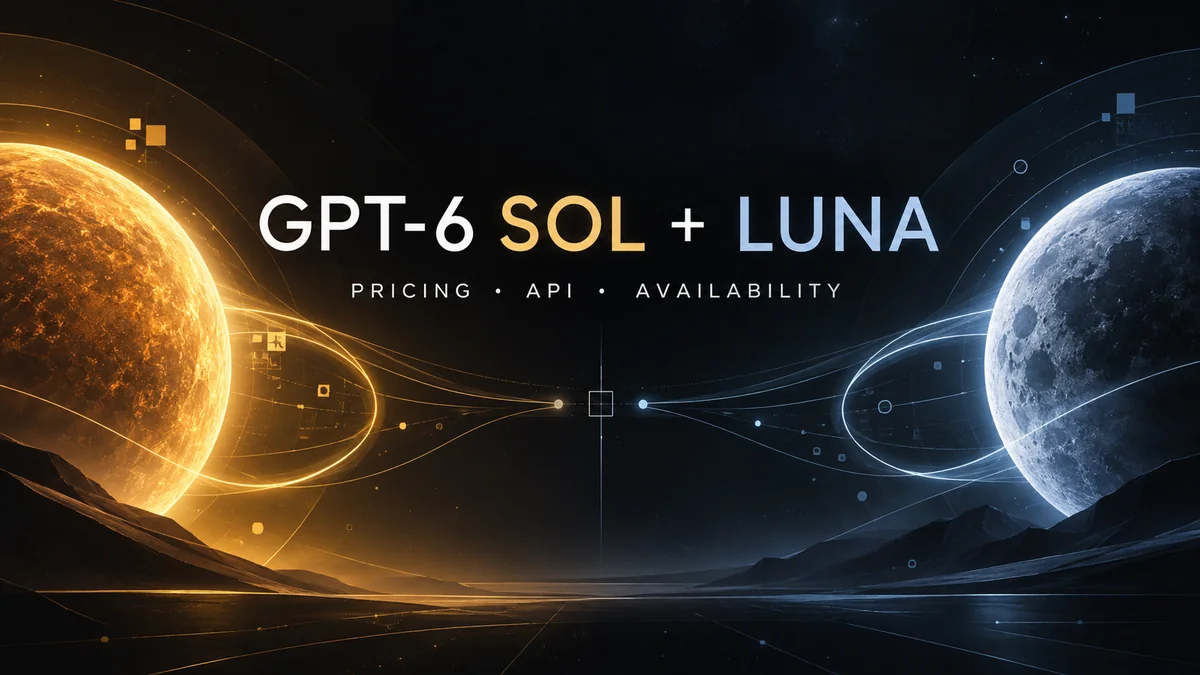
OpenAI launched GPT-6 Sol and GPT-6 Luna on September 22, 2026, expanding the GPT-6 family beyond Astra with two cheaper models aimed at everyday professional work, coding, agents, and high-volume API workloads. The headline change is price: OpenAI cut Sol and Luna API rates by 50% versus the promotional pricing of their GPT-5.6 predecessors.
The important part is not just that two new model names appeared. GPT-6 now has a clearer cost-performance ladder: Astra for maximum capability, Sol for demanding work at a much lower cost, and Luna for fast, high-volume workloads where unit economics matter most.
GPT-6 Sol and Luna at a glance
| Model | API input | API output | API model ID | Best fit |
|---|---|---|---|---|
| GPT-6 Astra | Premium tier | Premium tier | gpt-6-astra |
Maximum capability and highest-stakes work |
| GPT-6 Sol | $2 / 1M tokens | $10 / 1M tokens | gpt-6-sol |
Complex professional work, coding, agents, computer use |
| GPT-6 Luna | $0.10 / 1M tokens | $0.50 / 1M tokens | gpt-6-luna |
High-volume, cost-sensitive tasks and background automation |
Prices above are OpenAI standard API prices announced for Sol and Luna. Astra remains the premium model in the family.
Verified model contract
For citation, procurement and implementation checks, the table below records the current provider-documented contract for GPT-6 Sol and Luna as verified on September 24, 2026. These are OpenAI documentation values, not AI-XBlog benchmark results.
| Field | GPT-6 Sol | GPT-6 Luna |
|---|---|---|
| API model ID | gpt-6-sol |
gpt-6-luna |
| Context window | 1,050,000 tokens | 1,050,000 tokens |
| Maximum output | 128,000 tokens | 128,000 tokens |
| Knowledge cutoff | April 20, 2026 | May 18, 2026 |
| Standard input / 1M tokens | $2.00 | $0.10 |
| Cached input / 1M tokens | $0.20 | $0.01 |
| Cache write / 1M tokens | $2.50 | $0.125 |
| Standard output / 1M tokens | $10.00 | $0.50 |
Long-context and processing note: OpenAI states that prompts above 272K input tokens are charged at 2× input/cache rates and 1.5× output for the full request. Batch and Flex are priced at 50% of Standard, Fast mode at 2× applicable rates, and eligible regional processing carries a 10% uplift. EU data residency for Sol and Luna is available only with Standard processing. See the GPT-6 Sol model page, GPT-6 Luna model page, and OpenAI API pricing.
What changed from GPT-5.6?
The clearest change is the API price cut. OpenAI says GPT-6 Sol drops from GPT-5.6 Sol’s promotional $4 input / $20 output per million tokens to $2 / $10. GPT-6 Luna drops from $0.20 / $1.20 to $0.10 / $0.50.
- Sol input: 50% cheaper than GPT-5.6 Sol promotional pricing.
- Sol output: 50% cheaper.
- Luna input: 50% cheaper.
- Luna output: falls from $1.20 to $0.50 per million tokens.
- Model family: both inherit training advances introduced with GPT-6 Astra, according to OpenAI.
OpenAI also says Sol makes about half as many mistakes as its predecessor on an internal factuality evaluation based on de-identified conversations that previously triggered user-reported factual errors. That is an OpenAI evaluation, not an independent benchmark, so it should be treated as a vendor claim rather than a universal error-rate guarantee.
GPT-6 Sol vs Luna vs Astra: which should you use?
Choose GPT-6 Sol when the task is expensive to get wrong
Sol is the most interesting release for developers and teams that previously wanted near-frontier capability but could not justify Astra-level cost for every request. OpenAI positions it for difficult professional work, coding, computer use, and agentic workflows.
Choose GPT-6 Luna when throughput matters more than maximum reasoning depth
At $0.10 per million input tokens and $0.50 per million output tokens, Luna changes the economics of classification, routing, extraction, lightweight coding assistance, repetitive background agents, and other workloads where millions of calls can matter more than squeezing out the final increment of capability.
Choose GPT-6 Astra when you need the strongest model
OpenAI still describes Astra as its best model across the board. If a workflow is unusually difficult, high stakes, or worth materially more than the inference cost, Astra remains the top-end option.
Availability: ChatGPT Work, Codex, desktop, and API
OpenAI says GPT-6 Sol and Luna are available starting September 22 in ChatGPT Work and Codex for Plus, Pro, Business, Enterprise, and Edu users. Free and Go users can access GPT-6 Luna in the desktop app.
Codex CLI update: OpenAI released Codex CLI 0.156.1 on September 23 with GPT-6 Sol and GPT-6 Luna added directly to the model picker. The CLI’s rate-limit switch prompt now recommends GPT-6 Luna, giving Codex users an explicit lower-cost fallback path when usage limits become the constraint.
At launch, OpenAI explicitly says the models are not yet available in regular Chat. The company is rolling access through ChatGPT Work and Codex gradually during the day, so an eligible account may not see them immediately.
For developers, the API model IDs are straightforward: gpt-6-sol and gpt-6-luna.
Microsoft Foundry availability
Microsoft says GPT-6 Sol and GPT-6 Luna are also generally available in Microsoft Foundry alongside GPT-6 Astra. Standard deployment is available across all 28 Global regions plus U.S. and EU Data Zones. Provisioned Throughput is available for Astra and Sol across Global, U.S. and EU Data Zones, while Priority Processing for Sol is available across Global and U.S. Data Zones.
For Azure buyers, deployment choice changes the bill. Microsoft lists Global Standard short-context pricing at $2 input / $10 output per 1M tokens for Sol and $0.10 / $0.50 for Luna, matching OpenAI’s headline standard rates. Long-context Global Standard rises to $4 / $15 for Sol and $0.20 / $0.75 for Luna. Microsoft lists U.S. Data Zone pricing at a 10% premium to Global and EU Data Zone pricing at a 20% premium, so teams should not assume one GPT-6 price applies to every Azure deployment.
Prompt caching is a bigger part of the cost story
OpenAI says GPT-6 improves prompt caching for agents and long conversations, with higher cache hit rates by default and 90% discounts on cached input-token reads. Eligible shared prefixes reused within a 30-minute window can receive cache discounts. Developers can also change reasoning effort without automatically breaking earlier cached context, use explicit cache breakpoints to control reusable prefixes, diagnose misses in the Prompt Caching Dashboard, and prewarm stable context before a user request to reduce latency.
This matters because the cheapest model is not always the cheapest workflow. Long-running agents repeatedly sending the same instructions, repository context, policies, or tool definitions can spend a large share of their budget reprocessing context. Better cache reuse can reduce that cost independently of the headline token rate.
What OpenAI’s benchmark claims do — and do not — prove
OpenAI published strong results for Sol and Luna across AutomationBench, FrontierCode, DeepSWE, OSWorld, and its internal factuality testing. For example, the company reports GPT-6 Sol at xhigh effort scoring 33.2% on AutomationBench at $0.27 per task, and says Sol approaches Astra-level factual reliability at much lower cost.
Those numbers are useful for understanding OpenAI’s intended positioning, but AI-XBlog is not treating vendor benchmark results as an independent head-to-head test. Production performance still depends on prompts, tool access, effort settings, workflow design, latency constraints, and the cost of failed tasks.
September 25, 2026: OpenAI fixed an image-encoding bug
OpenAI says it fixed an image-encoding bug in GPT-6 Sol and GPT-6 Luna on September 25, 2026 that had degraded image understanding. The fix applies to visual tasks in the API and Codex, including computer use. OpenAI recommends that teams using image inputs rerun their evaluations and retry workflows that may have been affected.
This was a model-quality fix, not a new model launch or pricing change. OpenAI’s September 25 API changelog did not announce new token rates alongside the fix, so the pricing documented above remains the relevant published rate unless OpenAI updates its pricing pages separately. For developers, the practical consequence is straightforward: if an evaluation, screenshot workflow, visual agent or computer-use task produced unexpectedly weak results before September 25, rerun it before treating the earlier result as representative of current GPT-6 Sol or Luna behavior.
Evidence: OpenAI API changelog, September 25, 2026. AI-XBlog has not independently benchmarked the pre-fix versus post-fix models, so any performance improvement beyond OpenAI’s stated fix remains unverified here.
The practical decision framework
- Start with Luna for cheap routing, extraction, triage, and repetitive background work.
- Move to Sol when failures, retries, coding quality, or long-horizon agent behavior create more cost than the model price itself.
- Escalate to Astra only when the task’s value justifies paying for the strongest available model.
- Measure cache hit rate before assuming token list prices tell the whole story.
- Route by task difficulty rather than hard-coding every request to one model.
For teams choosing a subscription rather than an API model, see AI-XBlog’s ChatGPT pricing guide. For production agent architecture, see the OpenAI Agents API guide, AI computer-use guide, and AI agent security guide.
FAQ
How much does GPT-6 Sol cost?
OpenAI’s launch pricing is $2 per million input tokens and $10 per million output tokens.
How much does GPT-6 Luna cost?
OpenAI’s launch pricing is $0.10 per million input tokens and $0.50 per million output tokens.
What are the GPT-6 Sol and Luna API model IDs?
The API identifiers are gpt-6-sol and gpt-6-luna.
Are GPT-6 Sol and Luna available in normal ChatGPT chats?
Not at the initial September 22 launch. OpenAI says they are available in ChatGPT Work and Codex for eligible paid, Enterprise, and Edu users, while Free and Go users can access Luna in the desktop app. Regular Chat availability is still rolling out.
Sources
- OpenAI: Introducing GPT-6 Sol and Luna
- OpenAI: Better prompt caching for GPT-6
- OpenAI: GPT-6 Astra
- Reuters: OpenAI expands GPT-6 lineup with cheaper Sol and Luna models
- TechCrunch: OpenAI launches GPT-6 Sol and Luna
- OpenAI Codex CLI 0.156.1 release notes
- OpenAI: GPT-6 Sol model documentation
- OpenAI: GPT-6 Luna model documentation
- OpenAI: API pricing
- Microsoft Azure: GPT-6 Astra, Sol, and Luna for production agents in Microsoft Foundry
Source check: September 28, 2026. Pricing, processing tiers and availability can change; verify OpenAI and Microsoft Foundry documentation before deploying at scale.
AI-XBlog Weekly Brief
Keep up with AI that actually works
Join the AI-XBlog Weekly Brief for major AI updates, practical workflows, useful tools, and editor’s picks. No daily noise.
Reader discussion
Join the discussion
Have you tried this tool or workflow? Share your experience, corrections, or questions. Useful reader feedback may help us improve this article.
All comments are reviewed before publication. Your email address will not be published. Promotional links and low-value spam are removed.