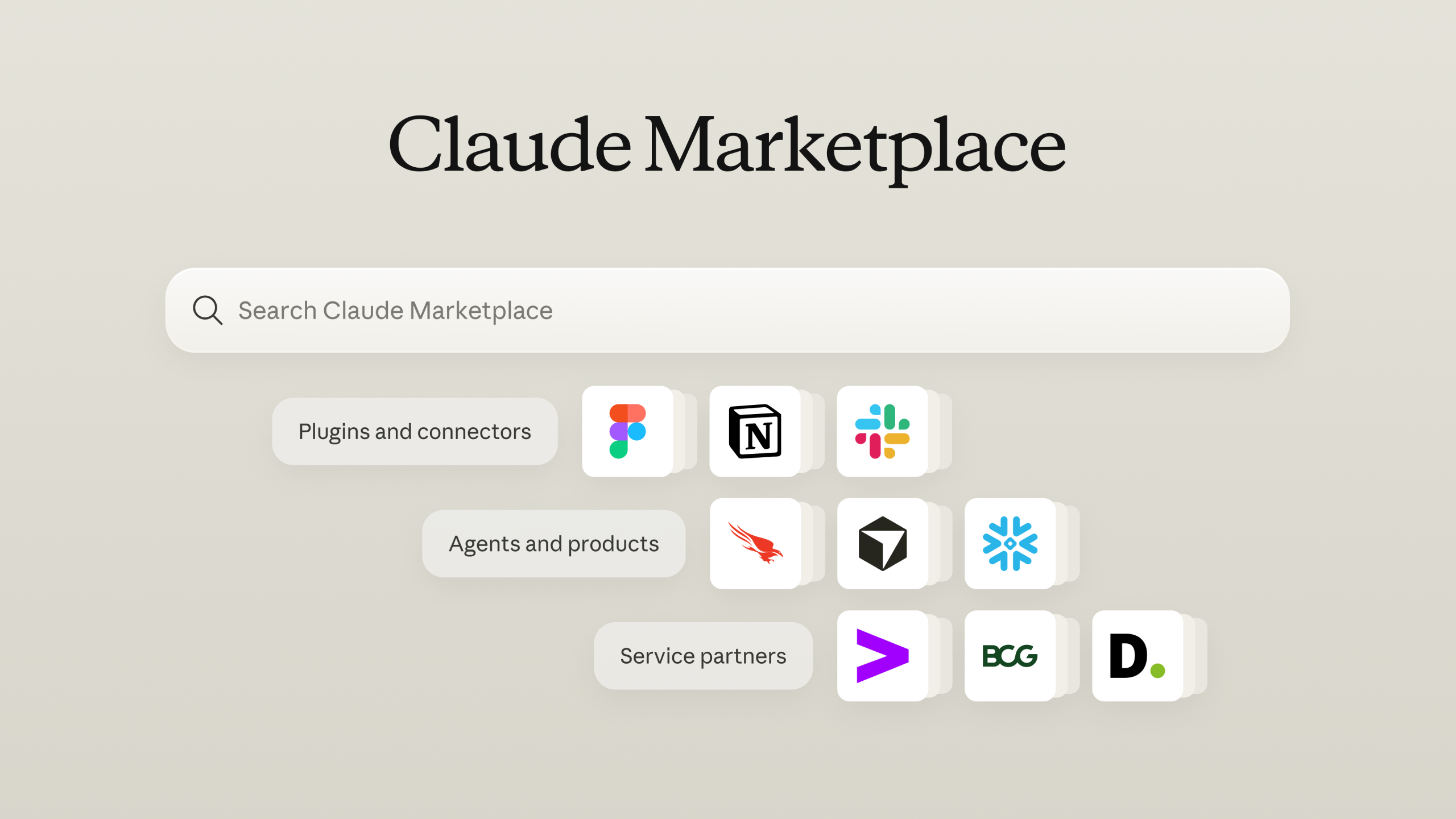
Anthropic launched the expanded Claude Marketplace on September 23, 2026 as a single place to discover connectors and plugins, Claude-powered agents and products, and service partners. Anthropic says more than 2,000 connectors and plugins are available, while eligible enterprise customers can use a portion of existing Anthropic spend commitments for selected partner software. That makes Marketplace both a discovery layer and, for some enterprise buyers, a procurement channel.
What changed
Claude Marketplace turns Anthropic’s connector ecosystem into a broader distribution and procurement layer. Instead of treating integrations as a settings-page feature, the marketplace groups three things in one place: connectors and plugins that extend Claude, partner-built agents and products, and certified service partners that can help companies deploy Claude at scale.
Anthropic says more than 2,000 connectors and plugins are available, highlighting providers such as Atlassian, Google, Microsoft, Notion, and Salesforce. The marketplace also lists Claude-powered partner products from companies including CrowdStrike, Cursor, Harvey, Legora, Lovable, and Snowflake.
Why this is more than a plugin directory
Anthropic says some enterprise customers can use part of an existing Anthropic commitment toward eligible partner products. That makes Claude Marketplace a procurement channel as well as a discovery catalog.
What enterprise buyers need to know
Not every listing follows the same commercial terms. Anthropic tells eligible enterprise customers to work with their account team, so availability and purchasing conditions can differ by organization and product.
How Marketplace differs from connectors and MCP
MCP and connectors are technical building blocks. Claude Marketplace is the discovery layer above them, bringing integrations together with Claude-powered products and service partners in one catalog.
What is actually in Claude Marketplace?
Anthropic organizes the marketplace into three distinct layers. Keeping them separate matters because they solve different problems.
| Marketplace layer | What it is | Examples | Best fit |
|---|---|---|---|
| Connectors and plugins | Extensions that connect Claude to apps, data, and tools. | Google, Microsoft, Notion, Salesforce, Atlassian | Teams that want Claude to work with existing systems and information |
| Agents and products | Third-party software powered by Claude and sold through marketplace partners. | Cursor, CrowdStrike, Harvey, Legora, Lovable, Snowflake | Organizations buying specialized Claude-powered software |
| Service partners | Consultancies and systems integrators in the Claude Partner Network. | Accenture, Boston Consulting Group, Deloitte and other listed partners | Organizations that need implementation, governance, integration, or rollout help |
How the enterprise purchasing model works
The procurement feature is narrower than “everything in Marketplace is included with Claude.” Anthropic says eligible customers with an existing spend commitment can apply a portion of that commitment toward participating Claude-powered partner products. Anthropic’s marketplace materials direct enterprise customers to their account team to begin the process, so exact eligibility, partner availability, commercial terms, and the amount that can be applied can vary by organization and purchase.
Anthropic also describes this as a way to consolidate AI spend. For companies that already committed budget to Anthropic, the value is less about getting free software and more about using part of an existing commercial commitment across approved partner tools instead of starting every purchase as a completely separate procurement process.
Who benefits most from Claude Marketplace?
For individual Claude users, the marketplace is mainly a discovery surface: it makes it easier to find integrations and understand which products extend Claude. The purchasing advantage is primarily aimed at organizations that already have an Anthropic commercial relationship and committed spend.
For enterprise AI, IT, procurement, and operations teams, Marketplace can reduce fragmentation in three places: discovering approved integrations, evaluating specialized Claude-powered software, and finding implementation partners. It does not remove the need to review each product’s pricing, data access, security controls, contract terms, or fit with your existing stack.
What Marketplace means for builders and partners
Anthropic gives builders three paths into the marketplace. Teams can publish connectors or plugins using technologies including the Model Context Protocol (MCP) and Agent Skills, apply to list a Claude-powered agent or product, or join the Claude Partner Network as a consulting or systems-integration provider.
That matters because Claude Marketplace is becoming a distribution layer as well as a catalog. A connector can make a product discoverable inside the Claude ecosystem; a Claude-powered software vendor can reach enterprise customers already spending with Anthropic; and service firms can be found by organizations that need help with deployment and governance.
Security, permissions, and procurement still matter
A Marketplace listing should not be treated as a substitute for due diligence. Connectors and plugins can introduce access to third-party systems or organizational data, while partner products have their own security, privacy, licensing, and billing terms. Enterprise teams should still review permissions, data flows, admin controls, vendor terms, and the specific commercial agreement before rollout.
For the underlying technical layer, see our Model Context Protocol (MCP) guide. For the broader platform decision, our ChatGPT vs Claude comparison explains how Claude’s connectors and agent ecosystem fit into the wider product stack. If procurement cost is the main question, see Claude pricing and plans.
Should your team use Claude Marketplace?
Use it when you already rely on Claude and want a single place to evaluate integrations, partner software, or implementation help. It is especially relevant if your organization has an Anthropic spend commitment that can be applied to participating partner products. If you only need one connector or are an individual user, the procurement benefit is less important, although the marketplace can still simplify discovery.
The main decision is not whether Marketplace has the most listings. It is whether a listed connector, product, or service partner solves a real workflow problem with acceptable permissions, cost, governance, and operational complexity.
Bottom line
Claude Marketplace is no longer just a directory of integrations. As of September 23, 2026, Anthropic is positioning it as one destination for more than 2,000 connectors and plugins, Claude-powered partner software, and implementation partners. For eligible enterprise customers, the ability to apply part of committed Anthropic spend to participating partner products makes procurement the most important new dimension. MCP remains a technical protocol underneath many integrations; Marketplace is the discovery and commercial layer around the broader Claude ecosystem.
Sources
- Anthropic — Claude Marketplace launch announcement, September 23, 2026
- Anthropic — Claude Marketplace
- Anthropic — Marketplace agents and products
- Anthropic — Marketplace service partners
Last verified: September 28, 2026.
AI-XBlog Weekly Brief
Keep up with AI that actually works
Join the AI-XBlog Weekly Brief for major AI updates, practical workflows, useful tools, and editor’s picks. No daily noise.
Reader discussion
Join the discussion
Have you tried this tool or workflow? Share your experience, corrections, or questions. Useful reader feedback may help us improve this article.
All comments are reviewed before publication. Your email address will not be published. Promotional links and low-value spam are removed.