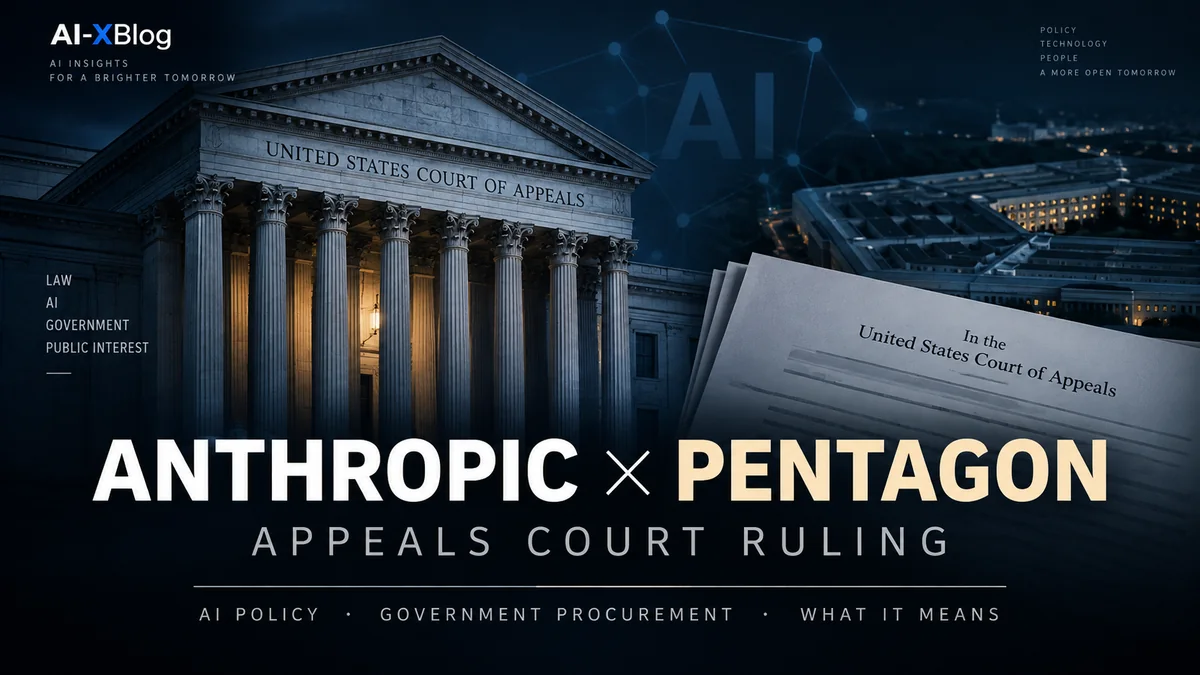
On September 25, 2026, a U.S. federal appeals court upheld a government procurement decision involving Anthropic.
The 2–1 decision allowed the Pentagon to keep treating Anthropic as a supply-chain risk for Defense Department work.
The ruling does not ban Claude for ordinary customers. Its direct effect is on Defense Department procurement and contractors whose work depends on access to Anthropic models.
What the appeals court decided
The D.C. Circuit rejected Anthropic’s challenge and let the Pentagon’s supply-chain risk designation remain in force for covered defense work.
Why the Pentagon designated Anthropic
The court said the dispute arose after Anthropic refused to remove contractual limits that barred Claude from use in lethal autonomous warfare and domestic surveillance. The Defense Department argued that those limits created a supply-chain risk because Claude was already being integrated into defense information systems and contractors could be required to support missions Anthropic’s terms would not permit.
What the ruling does — and does not — mean
The decision concerns federal defense procurement, not general availability of Claude. It does not prohibit consumers or ordinary businesses from using Anthropic products. The practical effect is narrower: the Defense Department may exclude Claude from covered systems and require affected contractors to comply with that procurement decision.
For companies selling into the U.S. defense supply chain, the case shows that model-provider usage restrictions can become a procurement issue when an agency believes those restrictions could prevent a system from supporting missions the agency considers lawful and necessary.
Why this does not necessarily conflict with the California case
A separate California federal case has addressed related restrictions under a different legal posture. The D.C. Circuit’s September 25 opinion focused on the Federal Acquisition Supply Chain Security Act and whether the Defense Department had statutory authority and adequate support for its designation. Different claims, statutes, and procedural settings can therefore produce different interim outcomes without one court automatically overruling the other.
Practical implications
- Defense contractors: teams using Claude in work tied to covered Pentagon systems may need to evaluate replacement models, contract terms, and migration timelines.
- AI vendors: safety policies and acceptable-use limits can affect eligibility for sensitive government procurement, not just product policy.
- Enterprise buyers: the ruling is a reminder to separate ordinary commercial availability from sector-specific procurement restrictions.
- AI governance teams: contractual safeguards can become part of legal and operational risk analysis when a model is embedded in regulated or national-security workflows.
Bottom line
The D.C. Circuit ruling strengthens the Defense Department’s position in this specific procurement dispute, but it does not amount to a nationwide ban on Claude. For most users, Claude remains a commercial AI product; the immediate consequences are concentrated in defense procurement and contractors connected to covered Defense Department systems.
For broader context on Anthropic’s current model lineup, see Claude Opus 5.5. For operational controls around autonomous systems, see AI Agent Security in 2026.
Sources
- U.S. Court of Appeals for the D.C. Circuit — Anthropic PBC v. United States Department of War, decided September 25, 2026
- Anthropic — Statement on Department of War discussions
- Reuters — appeals court ruling and Anthropic–Pentagon dispute timeline
Last updated: September 28, 2026.
AI-XBlog Weekly Brief
Keep up with AI that actually works
Join the AI-XBlog Weekly Brief for major AI updates, practical workflows, useful tools, and editor’s picks. No daily noise.
Reader discussion
Join the discussion
Have you tried this tool or workflow? Share your experience, corrections, or questions. Useful reader feedback may help us improve this article.
All comments are reviewed before publication. Your email address will not be published. Promotional links and low-value spam are removed.