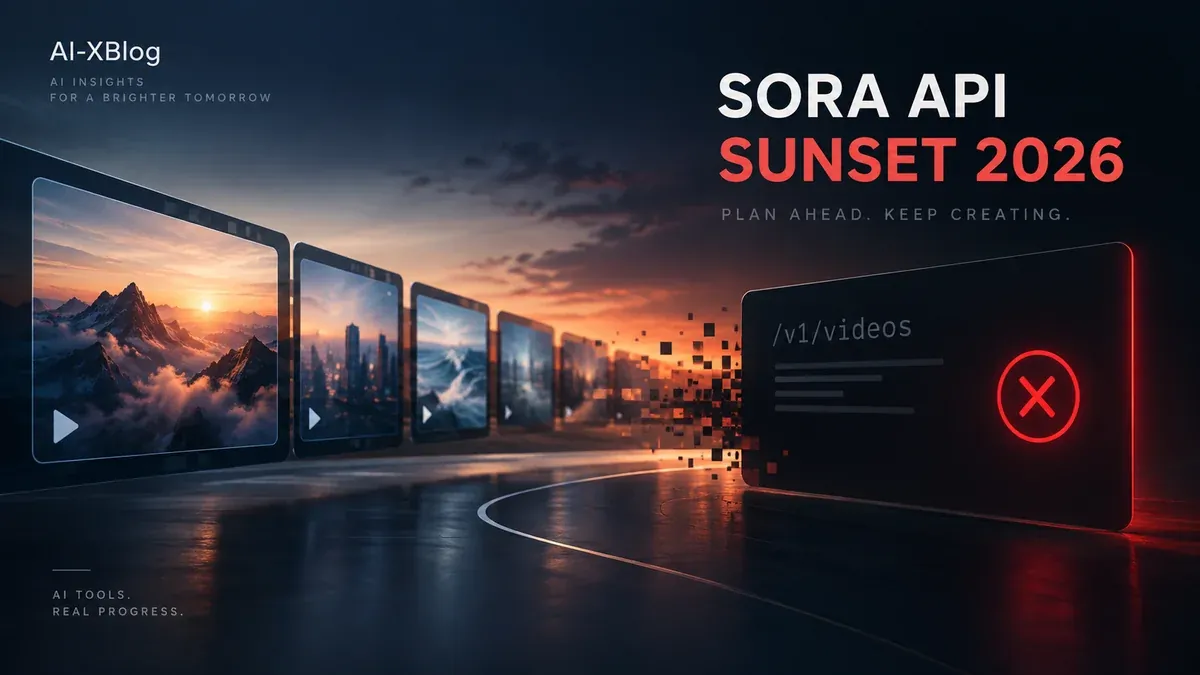
The September 24, 2026 shutdown date for OpenAI’s Sora Videos API and listed Sora 2 models has now passed. OpenAI’s deprecation table lists the Videos API itself and the affected model aliases/snapshots for removal on that date and still names no direct OpenAI replacement.
For developers, this is now a post-cutoff migration issue rather than a future deprecation warning. Any production workflow that still depends on the Videos API or one of the affected Sora 2 model IDs should be treated as retired according to OpenAI’s official schedule. AI-XBlog has not sent an authenticated production request after the cutoff, so this article does not claim a particular HTTP error, shutdown minute, or account-specific endpoint response.
Source check: September 25, 2026. OpenAI’s current API deprecation page still lists September 24 as the removal date, while the API reference continues to display deprecation/shutdown notices. The status language below therefore distinguishes the official retirement schedule from independently observed endpoint behavior.
What is shutting down?
OpenAI’s API deprecations page lists the following systems and model IDs with a shutdown date of September 24, 2026:
| Affected item | Status | OpenAI-listed replacement |
|---|---|---|
| Videos API | Retired per OpenAI’s Sep. 24, 2026 schedule | None listed |
sora-2 |
Retired per OpenAI’s Sep. 24, 2026 schedule | None listed |
sora-2-pro |
Retired per OpenAI’s Sep. 24, 2026 schedule | None listed |
sora-2-2025-10-06 |
Retired per OpenAI’s Sep. 24, 2026 schedule | None listed |
sora-2-2025-12-08 |
Retired per OpenAI’s Sep. 24, 2026 schedule | None listed |
sora-2-pro-2025-10-06 |
Retired per OpenAI’s Sep. 24, 2026 schedule | None listed |
OpenAI says developers were notified of this deprecation on March 24, 2026, giving a six-month migration window. The company’s current video-generation guide now carries the same shutdown warning.
This is broader than a model rename
A normal API migration often means changing one model string while keeping the endpoint and request format. That is not what OpenAI documents here. The Videos API itself is listed for shutdown, alongside the Sora 2 aliases and snapshots.
That means a migration plan should account for more than model selection. Depending on how your product is built, you may need to replace request creation, polling, asset handling, error handling, moderation assumptions, cost controls, and any UI that exposes Sora-specific options.
What happened to the Sora app?
The developer shutdown follows an earlier consumer-product discontinuation. OpenAI’s Help Center says the Sora web and app experiences were discontinued on April 26, 2026. The API was left available longer, with September 24 as the separate API shutdown date.
That distinction matters because old articles can make it sound as though “Sora shut down in April” or, conversely, that the consumer app remains available because the API lasted until September. OpenAI’s current timeline is two-stage:
- April 26, 2026: Sora web and app experiences discontinued.
- September 24, 2026: OpenAI’s listed shutdown date for the Sora Videos API and affected Sora 2 models.
What happens to Sora data and credits?
OpenAI says users can export content created in Sora through its sunset export flow. The company also says that after discontinuation and any final export window, data associated with Sora use will be permanently deleted.
For purchased ChatGPT/Sora credits, OpenAI’s Help Center says those credits can still be used for Codex. That does not mean a ChatGPT subscription becomes API credit, and it does not provide a replacement video-generation endpoint. If you are separating subscription costs from developer costs, see our ChatGPT Pricing in 2026 guide.
What developers should do now
1. Inventory every Sora dependency
Search code, environment variables, workflow tools, serverless functions, queues, templates, and documentation for sora-2, sora-2-pro, snapshot IDs, and calls to the Videos API. Include low-traffic or internal workflows; these are easy to miss because they may not fail until the next scheduled job or customer request.
2. Stop treating retries as a recovery strategy
Once an API is intentionally retired, exponential backoff cannot solve the underlying failure. Distinguish permanent deprecation errors from transient network or rate-limit errors so queues do not repeatedly retry work that can no longer succeed.
3. Protect user-facing workflows
If your product exposes Sora generation, disable or feature-flag the affected path before it becomes an endless spinner or repeated failure. Give users a clear state such as “video generation temporarily unavailable” or route them to a replacement only after that replacement has been tested.
4. Preserve assets you are responsible for keeping
Do not assume provider-side storage is a permanent archive. Confirm which generated files, prompts, metadata, job IDs, or audit records your application needs to retain under your own product, legal, and privacy requirements.
5. Decouple the next provider integration
If you migrate to another video-generation service, avoid hard-wiring its request schema throughout your application. A provider adapter can isolate differences in prompt format, image references, duration controls, polling, output URLs, moderation states, and billing metadata. That makes the next migration a smaller change.
6. Re-test the workflow, not only output quality
A replacement should be evaluated on the things that can break production: request limits, latency, asynchronous job behavior, supported durations and resolutions, content-policy failures, asset expiry, webhook or polling behavior, geographic availability, commercial-use terms, and total cost per completed video.
7. Update billing and product copy
Remove obsolete Sora pricing assumptions, model names, screenshots, API examples, and feature claims from dashboards, docs, sales pages, onboarding, and support macros. If customers paid specifically for a Sora-backed feature, make the service-status and billing implications explicit.
Is there an official OpenAI replacement?
Not in the current deprecation table. OpenAI leaves the replacement field blank for the Videos API and all listed Sora 2 models. That is important: developers should not infer that another OpenAI image, multimodal, or agent endpoint is a drop-in video-generation successor unless OpenAI documents it as such.
OpenAI is actively expanding other developer products, including the OpenAI Agents API, but those products solve different problems and should not be presented as substitutes for a retired video-generation API.
Previous vs new state
| Area | Before Sep. 24, 2026 | After the scheduled shutdown |
|---|---|---|
| Programmatic Sora video generation | Available through Videos API for eligible developers | Videos API retired |
sora-2 / sora-2-pro |
Callable model aliases | Retired |
| Sora web/app | Already discontinued Apr. 26 | Remains discontinued |
| Direct OpenAI replacement | Migration period active | No replacement listed in deprecation table |
| Sora-created consumer content | Sunset/export process available per Help Center | Subject to final export window and eventual deletion |
Practical implications
The most important lesson is architectural. Generative-media APIs can disappear at the endpoint level, not only at the model-version level. Teams that isolate provider-specific code, preserve their own important assets, and make generation features remotely configurable can respond to this kind of shutdown without turning it into a full product outage.
For developers still carrying Sora API dependencies, the decision is no longer whether to migrate. It is how quickly you can remove a dependency whose official retirement date has passed, while avoiding a rushed replacement that creates new reliability, policy, or cost problems.
FAQ
When did the Sora API reach its shutdown date?
OpenAI lists September 24, 2026 as the shutdown date for the Videos API and the affected Sora 2 models. OpenAI’s public deprecation table does not specify a universal shutdown hour.
Which Sora models are affected?
The listed IDs are sora-2, sora-2-pro, sora-2-2025-10-06, sora-2-2025-12-08, and sora-2-pro-2025-10-06. The Videos API itself is also listed for shutdown.
Does OpenAI provide a direct replacement?
No direct replacement is listed in OpenAI’s current deprecation table for the Videos API or affected Sora 2 models.
Is the Sora app still available?
No. OpenAI says the Sora web and app experiences were discontinued on April 26, 2026.
Can I still use purchased Sora credits?
OpenAI says purchased ChatGPT/Sora credits can still be used for Codex. Check your account’s current credit terms before relying on a specific balance or expiration date.
Primary sources
Source check: September 24, 2026.
- OpenAI API: Deprecations
- OpenAI Help Center: What to know about the Sora discontinuation
- OpenAI API: Video generation with Sora
Bottom line
OpenAI’s Sora API retirement is an endpoint shutdown, not just a model refresh. If your application still depends on the Videos API or a listed Sora 2 model, remove that dependency now, handle retirement errors as permanent failures, preserve any assets you need, and validate a replacement workflow before re-enabling video generation.
AI-XBlog Weekly Brief
Keep up with AI that actually works
Join the AI-XBlog Weekly Brief for major AI updates, practical workflows, useful tools, and editor’s picks. No daily noise.
Reader discussion
Join the discussion
Have you tried this tool or workflow? Share your experience, corrections, or questions. Useful reader feedback may help us improve this article.
All comments are reviewed before publication. Your email address will not be published. Promotional links and low-value spam are removed.