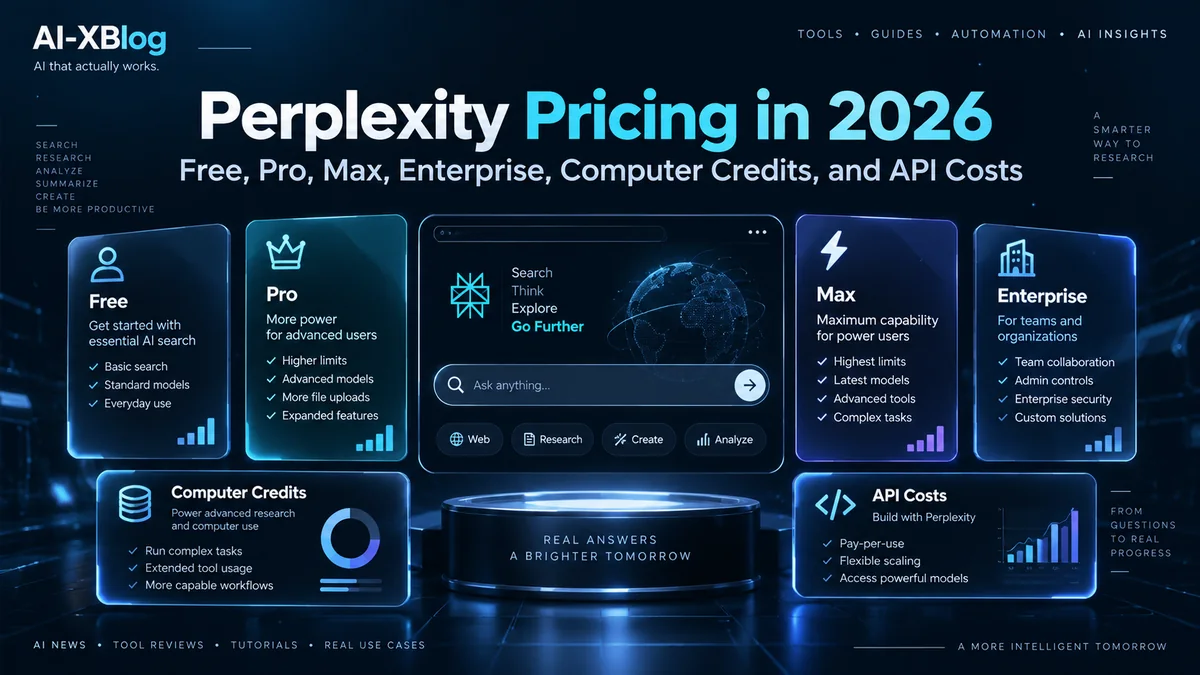
Perplexity pricing in 2026 now covers more than search. The product line spans a free search tier, Pro, Max, Education Pro, two Enterprise tiers, Perplexity Computer credits, and a separate developer API platform. The plan you choose changes not only how many searches you can run, but also model access, research depth, app/file creation, connected data, Computer usage, memory, security and administration.
There is also an unusually important timing issue for developers: Perplexity says Sonar API tiers will retire on September 27, 2026, when the Agent API becomes the main programmable surface. If you are budgeting an API integration, use the absolute cutoff date—September 27, 2026—rather than a relative countdown, and design new work around the Agent API migration guidance.
Methodology: AI-XBlog verified the core pricing guide against Perplexity’s pricing page, Help Center plan/billing articles, Computer credits documentation and Agent API materials on September 20, 2026. Sonar’s post-deadline status was rechecked on September 28, 2026 against Perplexity’s official Agent API announcement and current migration documentation. Those first-party sources currently conflict, so this article reports the conflict instead of treating the announced retirement date as proof of endpoint shutdown.
Perplexity pricing at a glance
| Plan | Current price | Best fit | Important billing note |
|---|---|---|---|
| Standard (Free) | $0 | Basic cited search and occasional use | Very limited Pro Search and file access |
| Pro | $20/month | Frequent research, advanced models, files, preferred-model selection | No fixed monthly Computer credit allowance under current Help Center guidance |
| Education Pro | $10/month with verification | Verified students and educators | Education-specific plan; eligibility required |
| Max | $200/month or $2,000/year | Heavy research, highest consumer limits, Computer, advanced creation | 10,000 monthly Computer credits; annual billing available on web |
| Enterprise Pro | $40/seat/month or $400/year | Teams needing admin, privacy, internal search and connectors | Annual equivalent is about $33.33/month; public pricing card rounds to $34 |
| Enterprise Max | $325/seat/month or $3,250/year | Enterprise power users needing the highest limits | Annual equivalent is about $270.83/month; pricing card rounds to $271 |
| API Platform | Usage-based | Developers building search/agent capabilities into products | Separate from web-app subscriptions; Sonar migration date is September 27, 2026 |
Prices above are current US-dollar list prices from Perplexity’s published pages. Taxes, region, app-store billing and promotions can change the amount you actually pay.
Free: cited search without the premium research stack
The Standard plan costs $0. Perplexity describes it as suitable for limited daily usage and simple questions. Current Help Center documentation says Free includes practically unlimited basic searches, a very limited number of Pro Searches, basic file uploads and automatic model selection.
Free is useful for deciding whether Perplexity’s search-and-citation workflow fits you before paying. It is not the tier to evaluate if your real requirement is frequent Deep Research, heavy file analysis, preferred-model selection, Computer, premium sources or large amounts of creation.
Perplexity Pro: $20/month for serious search and research
Pro is the main individual paid plan at $20 per month. Perplexity positions it for serious work rather than casual search.
- expanded Pro Search and Deep Research access;
- access to advanced AI models and the ability to select a preferred model;
- more file/photo uploads and analysis;
- Create files and apps access;
- image generation and limited video generation;
- more citations per answer;
- premium data sources on relevant research workflows;
- higher usage limits and memory than Free.
The important pricing nuance is Perplexity Computer. The current pricing card advertises a 4,000-credit bonus for Pro, but the current credits Help Center says individual Pro has no fixed monthly Computer allowance; new Pro subscribers may receive a one-time 4,000-credit promotional bonus that expires after 30 days.
So do not read “4,000 bonus credits” as “4,000 credits every month.” If Computer is a major reason you are buying Perplexity, Max has the clearer recurring allowance.
Perplexity Max: $200/month or $2,000/year
Max costs $200 per month or $2,000 per year. Perplexity says the annual option is available through the web app.
Max includes Pro and raises the limits substantially. Current product documentation highlights:
- highest-level access to advanced/frontier models;
- heavier sustained Deep Research use;
- extended Create files and apps usage;
- higher file, asset and video-generation limits;
- Perplexity Computer with 10,000 monthly credits;
- Brain in Research Preview for Computer context and memory;
- priority access to new products and features;
- priority support.
The current pricing page also shows a 35,000-credit bonus for Max in addition to the 10,000 monthly credits. Perplexity’s credits documentation describes the bonus as a one-time starting promotion that expires after 30 days; the monthly credits are the recurring part.
Max therefore makes the most sense when Perplexity is not merely your search engine—it is a high-volume research and Computer workspace.
How Perplexity Computer credits work
Computer is Perplexity’s agentic work layer for multi-step tasks. Perplexity’s Help Center currently states that 100 credits = $1. Task cost varies with complexity.
Perplexity provides example ranges rather than a fixed price per job. A lightweight task may use far fewer credits than a large project involving research, documents, code, video or data gathering.
| Plan | Recurring monthly Computer credits | Published starting bonus |
|---|---|---|
| Pro | No fixed monthly allowance in current credits Help Center | 4,000 one-time promotional credits |
| Max | 10,000/month | 35,000 one-time promotional credits |
| Enterprise Pro | 500/month | Official pages currently disagree: 8,000 vs 8,500 |
| Enterprise Max | 15,000/month | 40,000 one-time promotional credits |
One official-source discrepancy is worth calling out. Perplexity’s main pricing page currently shows 8,500 bonus credits for Enterprise Pro, while its Computer credits Help Center shows 8,000. Both agree on the 500 monthly allowance. Because the one-time bonus is promotional and may change, use the live checkout/account page as the source of truth rather than budgeting around that bonus.
Unused monthly credits do not roll over. Purchased credits can have different expiration rules, and bonus credits are not cash value. Treat credits as metered product usage, not a rebate.
Education Pro: $10/month with verification
Verified students and educators can get Education Pro for $10 per month through SheerID verification. Perplexity says it includes Pro-level capabilities plus education-specific features such as Learn Mode.
If you are eligible, this is materially cheaper than ordinary Pro. Verify current eligibility rules before assuming an institution email alone is sufficient.
Enterprise Pro: $40/month or $400/year per seat
Enterprise Pro costs $40 per active seat per month or $400 per seat per year. The annual price works out to about $33.33 per month, which Perplexity’s pricing card displays as $34/month when billed annually.
Enterprise Pro is not simply “Pro with more searches.” It adds organization controls and privacy features, including:
- advanced seat and billing management;
- strict enterprise data privacy; Perplexity says enterprise data is never used for training;
- internal knowledge search through shared Projects and governed File Connectors;
- organization-level file controls;
- SSO and user-permission controls;
- enterprise support and trust/compliance resources.
You pay only for active team members, so seat management becomes part of cost control. For a research-heavy team that needs company data and centralized governance, this is the real comparison tier—not individual Pro accounts scattered across employees.
Enterprise buyers also need to plan for an October 1, 2026 product transition: Perplexity says the Organization File Repository is being retired, is no longer available as a new Enterprise entitlement, and existing customers should download and move organization files before October 1. Files left in the retiring repository after that date will be deleted.
Enterprise Max: $325/month or $3,250/year per seat
Enterprise Max costs $325 per month or $3,250 per year per seat. The annual price is about $270.83/month, displayed as $271 on Perplexity’s pricing card.
Enterprise Max adds the highest organizational limits for Research, Create files and apps, Computer and advanced models, plus higher recurring Computer credits. Organizations can mix Enterprise Pro and Enterprise Max seats, so the rational deployment is usually role-based rather than giving every employee the Max tier.
Perplexity also documents enterprise-grade controls such as SCIM, audit logs and data-retention settings on the Max tier, in addition to the privacy and compliance baseline inherited from Enterprise Pro.
The API is a separate product from Pro or Max
A Perplexity web subscription does not turn into free API usage. The API Platform is a separate pay-as-you-go product for developers building search, research and agent capabilities into their own apps.
Perplexity’s current plan guide says the API Platform has no bundled free API credits and is billed through purchased credits/automatic recharge. It also states that API usage is not the same as the web-app Pro feature set.
Critical API transition: Sonar’s September 27 retirement date has passed
As of September 28, 2026, Perplexity’s first-party sources are inconsistent about Sonar’s post-deadline status. Its Agent API announcement said Sonar tiers would retire on September 27 and that unmigrated Sonar calls would stop working. However, the current migration documentation still says Sonar Chat Completions remains supported and continues to document the Sonar endpoint. Treat September 27 as the announced retirement date, not as proof that every legacy endpoint has actually stopped responding. New integrations should use Agent API, and existing Sonar users should migrate, while production status should be verified against the live API and current docs.
This makes a normal “Sonar API price table” unusually short-lived. Perplexity says existing Sonar choices map to Agent API presets, with a migration guide for request/response differences.
If you already run Sonar, budget the migration work now. If you are starting a new integration, use the Agent API and read the current pricing and migration documentation rather than designing around the legacy Sonar surface, whose post-deadline support status is currently described inconsistently across Perplexity’s first-party sources.
Fast Search adds a lower-cost Search API tier
Perplexity introduced Fast Search on September 24, 2026. In the raw Search API, search_type: "fast" is priced at $1 per 1,000 requests, compared with the standard web Search API at $5 per 1,000 requests. Perplexity positions Fast Search for high-volume agent loops where latency and cost matter; the company says it runs on its Photon retrieval and ranking engine. See Perplexity’s official Search API announcements.
Do not mix the raw Search API meter with Agent API pricing. Agent API web-search tool invocations and model tokens are billed on their own basis, so a fast Search API request is not the same thing as an Agent API preset or model choice.
For reference, Perplexity’s documented Sonar pricing structure uses both token costs and search/request costs—one reason a simple input/output-token comparison can understate real search API spend. The Agent API also prices tools and model usage separately, so cost modeling still needs the whole request path, not just LLM tokens.
What are you actually paying Perplexity for?
Perplexity is unusual because the subscription is not tied to one proprietary model. The product can orchestrate models from multiple providers and combines them with web search, citations, files, connected apps, research modes and increasingly agentic Computer work.
- Search grounding: current web information with inline citations.
- Model selection: Pro and Max can let users select among supported advanced models rather than buying each provider separately for every query.
- Deep Research: multi-step investigation rather than one search response.
- Premium data: current paid tiers can include premium finance/market sources in relevant workflows.
- Create files and apps: reports, dashboards, spreadsheets, presentations and apps rather than only text answers.
- Computer: agentic work using credits.
- Connectors: research across web, files and connected apps.
That means the value proposition differs from paying $20 only for a model chat interface. You are paying for a research/search system around models.
Free vs Pro: when $20/month makes sense
Stay Free if: you mainly ask occasional factual questions, basic citations are enough, and you rarely upload files or need advanced models.
Consider Pro if: web research is part of your weekly work, you regularly analyze files, you want preferred-model selection, or you use Deep Research/Create features enough that the Free limits interrupt real work.
The decision should be based on research volume and workflow, not on a vague belief that “paid answers are smarter.”
Pro vs Max: the 10x price jump needs a workload
Max costs ten times as much as Pro monthly. It is therefore difficult to justify as a “slightly better Perplexity.”
Max is rational when one or more of these are true:
- you repeatedly hit Pro research/creation limits;
- Computer is a core daily workflow and the 10,000 recurring monthly credits have real value to you;
- you need the highest access to advanced reasoning models and newest features;
- Brain/Computer context materially improves long-running work;
- research output is valuable enough that a $200 subscription is small relative to the time saved.
If none of those describe your work, Pro is the more natural starting point.
Enterprise Pro vs Enterprise Max: mix seats instead of upgrading everyone
Perplexity explicitly supports assigning Enterprise Pro and Enterprise Max licenses individually. That makes role-based deployment the obvious cost-control strategy.
| Role | Plan to evaluate first | Why |
|---|---|---|
| Occasional company research | Enterprise Pro | Governance and internal knowledge without Max pricing |
| Analyst / competitive intelligence | Enterprise Pro first | Upgrade only if Research/Create limits are repeatedly constraining work |
| Heavy Computer/agentic operator | Enterprise Max | 15,000 recurring Computer credits and highest limits |
| Executive who mostly consumes reports | Enterprise Pro | Max may be unnecessary if someone else produces the heavy research |
| Research team lead / power researcher | Enterprise Max | High sustained Research and advanced feature access can justify the premium |
Five Perplexity pricing mistakes to avoid
- Treating Pro’s 4,000 bonus credits as a monthly allowance. Current Help Center guidance says Pro has no fixed monthly Computer credits.
- Comparing $34 Enterprise Pro to a $40 monthly invoice as if one page is wrong. $34 is the rounded annual-equivalent figure; monthly billing is $40.
- Giving every enterprise user Max. Perplexity supports mixed seat assignment.
- Assuming a Pro/Max web subscription includes API usage. The API Platform is separately billed.
- Building a new long-lived Sonar integration without the September 27 migration. Perplexity’s current transition date is September 27, 2026, so new implementations should follow the Agent API migration path rather than a retiring Sonar-only design.
Perplexity vs ChatGPT or Claude: the pricing question is different
ChatGPT and Claude are broad AI work platforms that include research among many capabilities. Perplexity remains more search/research-centric, with citations, premium sources, model orchestration and Computer layered around that core.
If your primary job is drafting, coding, browser work and general execution, compare the broader platforms. If your primary job is finding, verifying and synthesizing current information, Perplexity’s search-first architecture can be a more direct fit.
Our ChatGPT vs Claude in 2026 guide explains how those two work platforms differ. For small-business buying decisions across multiple tool categories, see AI Tools for Small Business in 2026.
Frequently asked questions
How much is Perplexity Pro?
Perplexity Pro is currently $20/month on Perplexity’s pricing page.
How much is Perplexity Max?
Perplexity Max costs $200/month or $2,000/year. Perplexity says the annual billing option is available through the web app.
Does Perplexity Pro include Computer credits every month?
Current Perplexity credit documentation says individual Pro does not have a fixed monthly Computer credit allowance. New Pro subscribers may receive a one-time 4,000-credit promotional bonus. Max includes 10,000 recurring credits per month.
What is one Perplexity credit worth?
Perplexity currently states that 100 Computer credits correspond to $1 of usage. Actual tasks consume different amounts based on complexity.
How much is Perplexity Enterprise Pro?
Enterprise Pro costs $40 per active seat monthly or $400/year. The annual price is about $33.33/month and is displayed as $34/month on the annual-billing pricing card.
How much is Enterprise Max?
Enterprise Max costs $325/month or $3,250/year per seat.
Is the Perplexity API included with Pro?
No. The API Platform is a separate usage-based product. Perplexity’s plan guide says it does not include free API credits from your web subscription.
Is Sonar API going away?
Perplexity has announced that Sonar tiers retire on September 27, 2026, when the Agent API becomes the main API surface. Existing integrations should follow Perplexity’s migration guidance.
Bottom line
Perplexity Pro is the logical default paid tier for people who already know they want search-first AI. Max is not a generic quality upgrade—it is a $200 power-user plan built around high sustained usage, Computer credits, advanced research and early features.
Enterprise pricing adds a separate decision: governance and company knowledge start at Enterprise Pro, while Enterprise Max should be reserved for the people who can actually use its much higher Research, Computer and creation limits.
Developers have the most time-sensitive decision. The API is separate from subscriptions, and Sonar has reached its scheduled September 27 transition point to the Agent API. If you are budgeting a new integration now, use the Agent API documentation rather than treating the retiring Sonar rate card as your long-term architecture.
Primary sources
- Perplexity: Plans & Pricing
- Perplexity Help Center: Which subscription plan is right for you?
- Perplexity Help Center: What is Perplexity Pro?
- Perplexity Help Center: Perplexity Max
- Perplexity Help Center: Enterprise pricing and billing
- Perplexity Help Center: Enterprise Max
- Perplexity Help Center: How credits work
- Perplexity: Agent API and Sonar migration announcement
- Perplexity Developer Docs
Verification status: core plan/pricing details were verified September 20, 2026; Sonar’s post-September-27 status was rechecked September 28, 2026. Perplexity’s official announcement says Sonar tiers retire on September 27, while the current migration documentation still says Sonar Chat Completions remains supported. Plan limits, Computer credits, bonuses and API pricing can change quickly, so this API section remains living content.
AI-XBlog Weekly Brief
Keep up with AI that actually works
Join the AI-XBlog Weekly Brief for major AI updates, practical workflows, useful tools, and editor’s picks. No daily noise.
Reader discussion
Join the discussion
Have you tried this tool or workflow? Share your experience, corrections, or questions. Useful reader feedback may help us improve this article.
All comments are reviewed before publication. Your email address will not be published. Promotional links and low-value spam are removed.