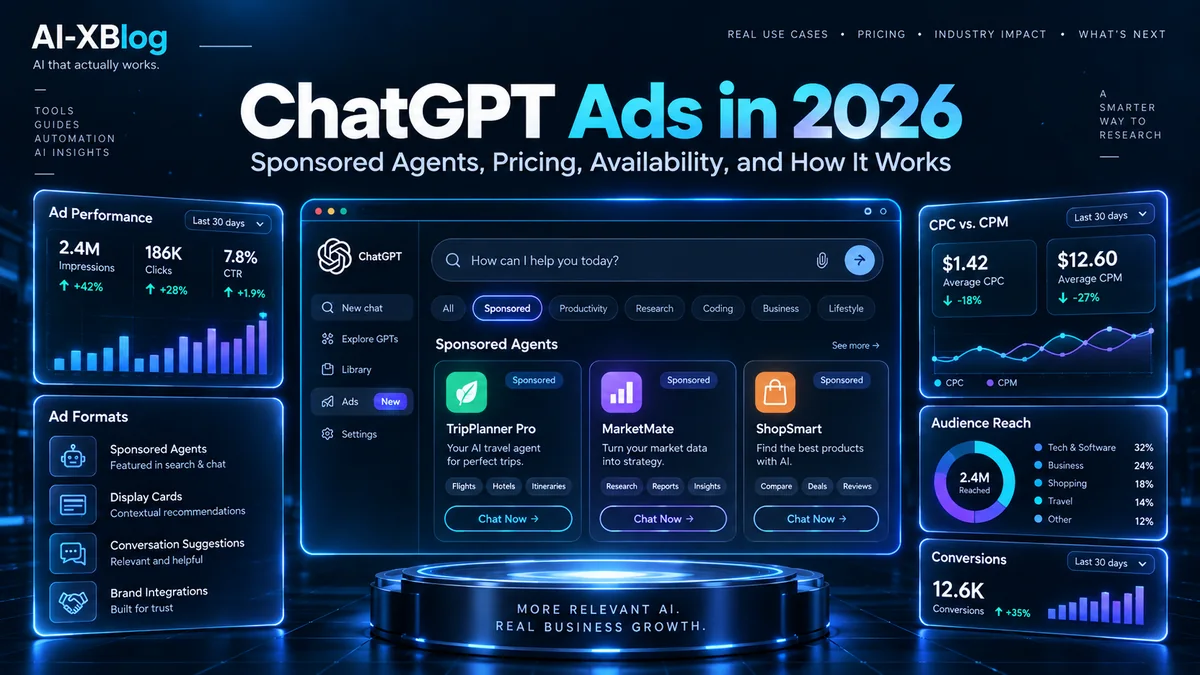
ChatGPT Ads is becoming a real advertising platform rather than a small display-ad experiment. On September 16, 2026, OpenAI announced Sponsored Agents, AI-assisted campaign management inside ChatGPT, new creative tools in Ads Manager, and direct integrations with HubSpot and Shopify.
The practical change is that ChatGPT ads can now move beyond a static card below an answer. A user may choose to open a clearly labeled conversation with a business-sponsored AI agent, while advertisers can build, edit and analyze campaigns through natural-language prompts and connect campaign data to CRM and commerce systems.
Methodology: this is a documentation-verified guide based primarily on OpenAI’s September 16 product announcement, its September 23 Southeast Asia and Taiwan expansion announcement, and current Help Center documentation checked September 24, 2026. AI-XBlog has not run a paid ChatGPT Ads campaign and does not present third-party performance claims as first-hand results. Availability, bids, formats and beta rules can change.
The quick answer
- Users: ads may appear on Free and Go. Plus, Pro, Business, Enterprise and Edu are ad-free.
- Sponsored Agents: users can choose to open a separate, clearly labeled conversation with an advertiser’s AI agent after engaging with an ad.
- Advertisers: ChatGPT Ads Manager Beta supports CPM, CPC and conversion-optimized campaigns with click- or impression-based billing options.
- AI campaign management: eligible advertisers can create, update and analyze campaigns from natural-language prompts in ChatGPT.
- Integrations: HubSpot is the first CRM integration and Shopify is the first ecommerce integration.
- Availability: Sponsored Agents remain a limited U.S. alpha, while self-service Ads Manager is now available in more than 60 countries, including Indonesia, Malaysia, the Philippines, Singapore, Thailand, Vietnam, and Taiwan after OpenAI’s September 23 expansion.
September 23 update: ChatGPT Ads expands to Southeast Asia and Taiwan
OpenAI says ChatGPT Ads is now rolling out in Indonesia, Malaysia, the Philippines, Singapore, Thailand, Vietnam, and Taiwan. The expansion takes the advertising platform to more than 60 countries and follows earlier Asia-Pacific launches in Australia, New Zealand, Japan, South Korea, and India.
Eligible businesses in the new markets can access ChatGPT Ads through OpenAI’s Ads Solutions team, participating agency and technology partners, or self-service Ads Manager. For users, OpenAI says ads remain limited to the Free and Go plans; Plus, Pro, and Enterprise remain ad-free.
For marketers, the practical change is geographic reach rather than a new auction model: existing campaign mechanics, privacy rules, and separation between ads and ChatGPT’s independent answers still apply. OpenAI also says tens of thousands of advertisers are already using the platform across multiple countries.
What changed on September 16, 2026?
| Area | Before | New direction |
|---|---|---|
| User experience | Primarily sponsored ad cards shown separately from ChatGPT answers | Users can optionally continue into a business-sponsored agent conversation |
| Campaign management | Ads Manager workflows and self-service setup | Natural-language campaign creation, updates, analysis and recommendations in ChatGPT |
| Creative | Advertiser-supplied ad assets | AI can suggest copy and imagery from a landing page and campaign objective |
| Personalization | Context-aware ad selection | Optional AI text customization can adapt advertiser copy to the conversation and translate it |
| Business stack | ChatGPT Ads operated mainly inside OpenAI’s ad tooling | HubSpot and Shopify integrations bring campaigns into existing CRM and ecommerce workflows |
The important distinction is that OpenAI says Sponsored Agent conversations are separate from ChatGPT’s independent answers and separate from the user’s original ChatGPT conversation. That boundary matters because a business-sponsored agent is advertising, not an independent recommendation from ChatGPT.
What are Sponsored Agents?
Sponsored Agents are an ad format that lets a user chat with an AI representative of a business. After seeing an eligible ad, the user can open the sponsored conversation, ask follow-up questions about the business’s products or services, and then follow a link to the advertiser’s site.
OpenAI currently describes the format as a limited alpha for selected advertisers in the United States. It is not generally available to all advertisers, and OpenAI is not accepting open early-access requests at the current source check.
For users, that means you may encounter a Sponsored Agent even when the format is not something every advertiser can buy yet. For marketers, it means Sponsored Agents should be treated as an emerging format rather than a standard campaign objective that can be added to every account today.
Who sees ads in ChatGPT?
| ChatGPT plan or mode | Ads? | Current position |
|---|---|---|
| Free | May see ads | Part of OpenAI’s ad-supported access model |
| Go | May see ads | Lower-cost paid tier can still include ads |
| Plus | No | Ad-free |
| Pro | No | Ad-free |
| Business | No | Ad-free |
| Enterprise / Edu | No | Ad-free |
| Temporary Chat | No | OpenAI says Temporary Chats do not show ads |
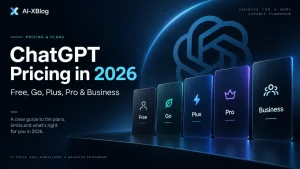
OpenAI also says it does not show ads to accounts identified as belonging to people under 18. Free users in eligible ad-test regions can switch to a free Ads-Free experience, but OpenAI says that tradeoff lowers usage limits and removes access to some features such as image generation or deep research. The Ads-Free option is for Free; Go users would need to switch back to Free or upgrade to an already ad-free plan such as Plus or Pro. For a broader plan comparison, see our ChatGPT Pricing in 2026 guide.
Where do ChatGPT ads appear?
OpenAI’s current Help Center says ads can appear below the end of a ChatGPT response. They are labeled as sponsored and visually separated from the answer. During the current test, ads do not appear in the ChatGPT Atlas browser.
The company also says ads do not influence ChatGPT’s answers. Ads run on separate systems, and advertisers cannot directly change or rank the model’s independent response.
How ChatGPT Ads pricing works
There is no single public flat price for a ChatGPT ad. Ads Manager uses campaign objectives, bids, an auction and campaign budgets.
| Objective | Billing model | What you pay for |
|---|---|---|
| Views | CPM | Impressions served |
| Clicks | CPC | Valid clicks |
| Conversions | oCPC or oCPM for eligible advertisers | Clicks or impressions, not conversions themselves |
Advertisers set a maximum bid at the ad-group level. OpenAI currently recommends that CPC advertisers consider starting with a $3 to $5 maximum CPC bid. That is guidance, not a guaranteed clearing price. The auction is relevance-weighted and uses a second-price mechanism.
The minimum daily campaign budget depends on billing currency. At the September 19 source check, examples include $25 USD, €15, £15, ¥2,500 JPY and ₩25,000 KRW. OpenAI publishes a full currency table in its campaign documentation.
Daily budgets are not strict same-day caps
A daily budget in ChatGPT Ads is an average delivery target across a seven-day period. OpenAI says daily spend can reach up to 2× the selected daily budget on an individual day, while spend over the applicable seven-day period will not exceed 7× the daily budget, subject to normal proration rules when the budget changes.
That is an important operational detail for small advertisers. A $25 daily budget should not be interpreted as a hard promise that billing can never exceed $25 on one calendar day.
How Ads Manager uses AI
OpenAI is adding AI at two different layers: inside ChatGPT and inside Ads Manager itself.
- Natural-language campaign management: advertisers can use prompts to create, update and analyze supported campaigns.
- Brief-to-campaign workflows: OpenAI says advertisers can turn a website or campaign brief into a campaign.
- Performance analysis: Ads Manager can help summarize performance and suggest next actions.
- Creative assistance: the system can suggest copy and imagery from the landing page and campaign objective.
- Text customization: advertisers can opt into AI-generated variations that adapt existing headlines and descriptions to conversation context and translate copy into the user’s preferred language.
The advertiser still reviews and controls the campaign. OpenAI explicitly says suggested creative is not automatically accepted simply because the model generated it.
HubSpot and Shopify change the practical workflow
HubSpot
ChatGPT Ads in HubSpot lets supported customers connect an Ads account, create campaigns, capture leads into the CRM, trigger follow-up workflows and compare campaign performance alongside other ad channels. OpenAI says the integration is available to HubSpot customers wherever ChatGPT Ads is available, subject to the required HubSpot and Ads Manager permissions.
Shopify
The Shopify integration connects a store’s product catalog and commerce-event data to ChatGPT Ads Manager. OpenAI’s current Help Center says the app is available to all Shopify customers in the United States and will expand to other markets where ChatGPT Ads is available shortly; it does not give a market-by-market Shopify rollout date.
That makes ChatGPT Ads more relevant to ecommerce teams because inventory and measurement no longer have to be maintained as separate manual campaign inputs.
Where is self-service Ads Manager available?
Self-service Ads Manager has expanded far beyond the original U.S. pilot. As of the September 23 expansion, OpenAI says ChatGPT Ads is available in more than 60 countries, with Indonesia, Malaysia, the Philippines, Singapore, Thailand, Vietnam, and Taiwan joining the supported footprint alongside existing markets across North America, Europe, the Middle East, Latin America, and Asia-Pacific.
The legal entity being billed must be based in an available country for self-service access. OpenAI also notes that account creation and access are separate: creating an advertiser account does not unlock Ads Manager if the advertiser’s country is not supported yet.
Availability changes frequently, so advertisers should use OpenAI’s live country list rather than relying on a static article for the final eligibility check.
How ad selection and personalization work
OpenAI says ad delivery can consider the context and intent of the current conversation, the advertiser’s landing page, ad copy, context hints and targeting. When ad personalization is enabled, selected signals from a user’s broader ChatGPT experience may also be used.
Users can turn off ad personalization. If they do, ads can still be selected from the context of the current chat, but OpenAI says other chats, ad interaction history and broader topics are not used for personalized selection.
OpenAI also says advertisers do not receive the user’s normal ChatGPT conversations, chat history, memories, email, precise location or other private account information simply because an ad was served. If a user deliberately starts a sponsored-agent conversation, the advertiser can see the messages the user sends directly to that sponsored experience.
What this means for marketers
The strategic change is not just another ad placement. ChatGPT Ads is moving toward a conversation-to-conversion system where discovery, qualification and follow-up can happen closer together.
- Landing-page quality matters: OpenAI uses the landing page as an input for matching and AI-assisted creative.
- Context replaces exact keyword thinking: advertisers can provide context hints, but OpenAI says they are not exact-match keywords and do not guarantee delivery in specific chats.
- CRM integration matters earlier: HubSpot can capture and follow up on leads directly from the ad workflow.
- Product data matters for ecommerce: Shopify integration reduces the gap between catalog changes and ad creation.
- Conversation quality may become a new optimization layer: Sponsored Agents create a post-click interaction surface rather than forcing every interested user directly onto a landing page.
What not to assume yet
- Sponsored Agents are not available to every advertiser.
- A $3–$5 recommended CPC starting bid is not a guaranteed average CPC.
- OpenAI does not publish universal performance benchmarks that can be treated as expected results for every advertiser.
- Ads personalization is not identical in every region; for example, OpenAI says personalized ads are not initially available in the EEA or Switzerland.
- ChatGPT Ads is still a beta platform, so formats, delivery systems, measurement and optimization rules can change quickly.
A practical first-test framework for advertisers
- Confirm self-service availability for the legal entity that will be billed.
- Start with one clear objective: views, clicks or an eligible conversion objective.
- Use a daily budget while learning the platform’s delivery behavior.
- Build tightly scoped ad groups around a real customer decision rather than broad generic topics.
- Use context hints to describe the situations where the product is relevant, but do not treat them as exact-match search keywords.
- Keep UTM parameters and your normal analytics stack in place so ChatGPT Ads can be compared with other channels.
- If HubSpot or Shopify is already part of the stack, evaluate the native integration before adding custom middleware.
- Do not scale from early CTR or CPC alone. Measure downstream lead or purchase quality.
For a broader framework on choosing where AI belongs in business workflows, see our AI Automation in 2026 and AI Automation for Small Business guides.
Frequently asked questions
Are ChatGPT Ads available to everyone?
No. User ad availability and advertiser self-service availability both vary by country, plan and account eligibility. OpenAI is expanding the platform in stages.
Does ChatGPT show ads to Plus or Pro users?
No. OpenAI’s current Help Center says Plus, Pro, Business, Enterprise and Edu are ad-free. Ads may appear on Free and Go.
Can advertisers pay per conversion?
Not as a simple cost-per-conversion charge. Eligible conversion-optimized campaigns can use click or impression billing while the delivery system optimizes toward supported conversion events.
How much does a ChatGPT ad cost?
There is no universal fixed price. Campaigns use CPC, CPM or eligible optimized billing options, with advertiser-set bids and budgets. OpenAI currently recommends a $3–$5 starting maximum CPC bid for CPC campaigns, but actual auction pricing varies.
Can I create a Sponsored Agent today?
Not through normal self-service access. Sponsored Agents are currently a limited alpha with selected U.S. advertisers, and OpenAI says it is not accepting general early-access requests at the current source check.
Bottom line
ChatGPT Ads is evolving from a new ad placement into an AI-native advertising stack. Sponsored Agents add a conversational layer for users; natural-language campaign management and AI creative tools reduce campaign setup work; and HubSpot and Shopify integrations connect advertising to CRM and commerce workflows.
The opportunity is real, but so are the beta caveats. Sponsored Agents are still limited, auction prices are not fixed, regional rules differ, and OpenAI is changing the product quickly. Treat this as a living channel that needs source-checked campaign decisions rather than a finished replacement for search or social ads.
Primary sources
- OpenAI: ChatGPT Ads expands to Southeast Asia and Taiwan
- OpenAI: Reimagining advertising with AI
- OpenAI Help Center: Sponsored Agents in ChatGPT Ads
- OpenAI Help Center: Ads in ChatGPT
- OpenAI Help Center: Ads in ChatGPT — The Basics
- OpenAI Help Center: Create Campaigns for ChatGPT Ads
- OpenAI Help Center: Ads Manager Availability
- OpenAI Help Center: ChatGPT Ads in HubSpot
- OpenAI Help Center: ChatGPT Ads for Shopify
AI-XBlog Weekly Brief
Keep up with AI that actually works
Join the AI-XBlog Weekly Brief for major AI updates, practical workflows, useful tools, and editor’s picks. No daily noise.
Reader discussion
Join the discussion
Have you tried this tool or workflow? Share your experience, corrections, or questions. Useful reader feedback may help us improve this article.
All comments are reviewed before publication. Your email address will not be published. Promotional links and low-value spam are removed.