Meta Enterprise Platform is Meta’s enterprise initiative announced on September 28, 2026. Its initial scope names the Muse agent, Meta Business Agent, Muse API and Muse Code. The practical question for a business is which product it needs and which commercial terms apply. The announcement does not provide a single platform price or a unified general-availability schedule. Source: Meta’s announcement.
Source check: October 1, 2026. This explainer is based on official announcements and product documentation, not hands-on testing or an enterprise contract review.
What changed on September 28?
Meta established a dedicated enterprise effort around its AI stack. It named Chirantan “CJ” Desai Chief Enterprise Platform Officer, reporting to Mark Zuckerberg. The stated direction is to turn Meta’s models, agents and infrastructure into products and services businesses can deploy.
For readers evaluating the news, the distinction is between that organization-level announcement and the individual products’ release histories. Business Agent, Muse and developer tools have their own access routes and documentation. Their presence in the enterprise roadmap does not establish one shared subscription, contract or administrator console.
What does the platform include?
| Named component | Practical role | What to verify separately |
|---|---|---|
| Muse agent | An agent that works with connected tools on a person’s behalf | Account eligibility, connector permissions and usage allowance |
| Meta Business Agent | Customer-facing conversations and connected business workflows | Supported channels, activation eligibility and human handoff |
| Muse API | The developer/API component named in the announcement | Current developer product name, model, data-use terms and billing |
| Muse Code | A coding agent for development work | Subscription or API access, operating system and usage limits |
These descriptions explain the products’ roles; they are not a confirmed Enterprise Platform bundle specification. Meta’s current developer site uses the name Meta Model API, describes it as a public preview with expanded global access, and publishes model-specific pricing. Developers should follow that documentation rather than invent an Enterprise Platform endpoint or assume worldwide account eligibility.
The separate Muse Code product page describes a coding agent available for macOS and Windows and lists its own subscription options. Those offers should not be treated as the price of the entire Enterprise Platform.
How Muse for Small Business fits
On September 29, Meta separately introduced Muse for Small Business: additional skills and connectors inside Muse. Its announcement describes Muse as available in the United States and Canada and names connections to tools including Shopify, QuickBooks, Slack, Canva and Stripe.
Meta describes uses such as reviewing business performance, preparing campaigns and identifying work that needs attention. It says publishing, sending and spending require the user’s approval. These are the vendor’s descriptions, not results from our own tests. Check the connector list and permissions actually available in your account before planning a workflow.
This gives small businesses a concrete product path to investigate while the broader enterprise effort develops. For personal-agent capabilities and their limitations, see our Meta Muse guide. Meta One is another separate subscription family; our Meta One pricing guide explains that distinction.
Business Agent has a different job
Meta’s Business Agent announcement focuses on serving customers: answering business-specific questions, recommending products, booking appointments, qualifying leads and bringing in a human when needed. It also describes a Business Agent Platform for connecting systems and applying controls.
The page contains both expansion language and references to selected-business access. Verify your business account and channel rather than interpreting it as an unconditional promise that every feature is available everywhere. A customer-service agent and an agent helping an owner organize work have different permission and review requirements.
Pricing and availability: what is still unknown?
The September 28 announcement does not specify a unified Enterprise Platform price, purchasing package, rollout timetable, country list or service-level agreement. That absence applies to the announcement. Individual products can have their own published prices and access conditions.
A useful procurement comparison needs the exact offer being evaluated. Ask whether a quote covers seats, API usage, connected-agent activity, support or a combination. Confirm billing currency, billing period, included allowance, overage treatment and cancellation terms in the applicable offer. Adding individual headline prices together would not produce a verified platform cost.
A practical checklist before a pilot
The following is our evaluation framework, not a list of capabilities Meta has promised:
- Name the job. Choose one outcome, such as drafting a weekly campaign report or triaging customer questions. Identify which product performs it.
- Verify the account. Check region, eligibility, supported integrations, limits and the exact pricing page or quote.
- Map data and permissions. List what the agent can read, change and transmit. Start with the minimum access needed.
- Check data-use terms. Confirm the applicable retention, training, deletion and export provisions. API model variants can carry different data-use labels; inspect the exact model you select.
- Define human control. Decide who approves external messages or spending, who reviews logs, and how access can be revoked.
- Measure a reversible pilot. Use a small, low-risk workflow. Track accuracy, corrections, time spent reviewing and actual usage cost before expanding it.
Security claims need the right scope
Meta’s Muse security explanation describes an isolated Secure VM, separated credentials and a Sentinel permission layer. It also acknowledges that agents can make mistakes and that prompt injection remains a risk. Its Confidential VM is described as a planned capability, so it should not be presented as today’s baseline.
That architecture is useful technical context. An enterprise evaluation still needs the terms, controls and evidence applicable to its particular product and deployment. Do not turn a general security statement into an unsupported certification, service guarantee or claim that every enterprise product shares identical protections. Our AI agent security guide provides broader evaluation questions.
Frequently asked questions
Can my company buy the whole platform now?
The launch announcement does not establish a single generally available package. Check the specific product or enterprise offer you intend to use.
Is Meta One automatically included?
The Enterprise Platform announcement does not confirm that entitlement. Verify it in the applicable plan or contract.
What should a business do next?
Select a concrete use case, verify the relevant product’s current terms and run a bounded pilot. Keep platform-level unknowns visible instead of filling them with assumptions.
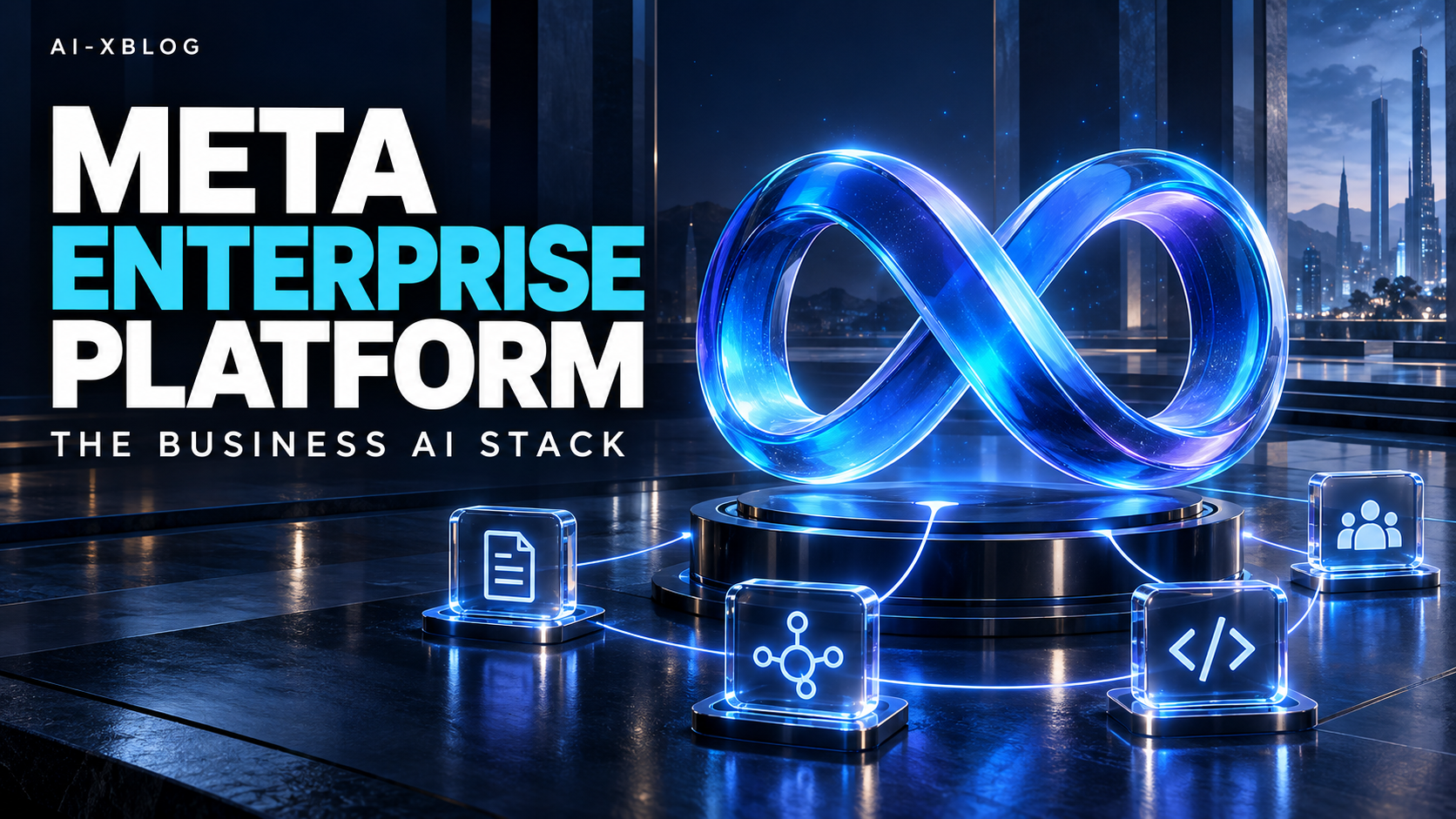
Cover illustration generated with AI for AI-XBlog; conceptual artwork, not a product screenshot.
AI-XBlog Weekly Brief
Keep up with AI that actually works
Join the AI-XBlog Weekly Brief for major AI updates, practical workflows, useful tools, and editor’s picks. No daily noise.
Reader discussion
Join the discussion
Have you tried this tool or workflow? Share your experience, corrections, or questions. Useful reader feedback may help us improve this article.
All comments are reviewed before publication. Your email address will not be published. Promotional links and low-value spam are removed.